Categories
Grants and Sponsorships

CPF Conference

California Preservation Foundation Conference - May 8-11, 2019 SPONSORSHIP

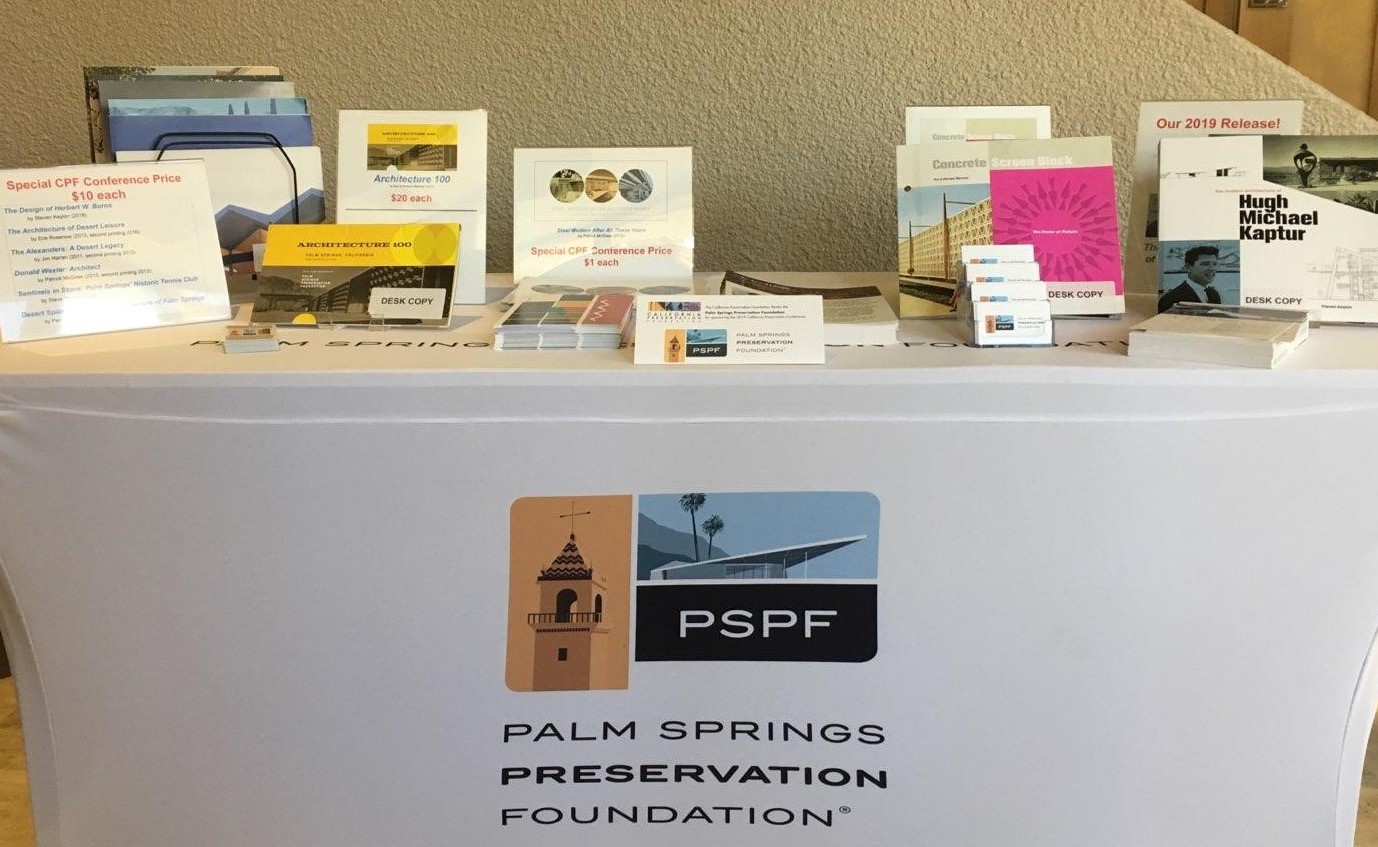
PSPF was proud to be the Lead Sponsor of this year’s CPF conference whose theme, “Preservation Springs Eternal,” invited attendees to “reflect back on battles won and lost, and to look forward to the next generation of preservationists and preservation technologies.” The exciting schedule of events included more than 40 sessions, workshops, tours, and receptions. PSPF board president Gary John was the Plenary Session keynote speaker. Gary presented a special edition of his popular Lost, Saved & Endangered lecture. A PSPF information booth was staffed during the conference and attendees were engaged about PSPF’s local preservation efforts.

PSPF board member Gary Johns and PSPF administrative officer Gerry Ragucci were members of the conference Steering Committee, and PSPF board member Steven Keylon was on the Program Committee.

To see the PSPF program page click here.

To read the PSPF Welcome Letter click here.

PSPFatCPF
CPFSponsorBannerRight
Categories
Grants and Sponsorships

Kaptur Exhibition

Hugh Kaptur: Organic Desert Architecture - February 2-July 7, 2019 SPONSORSHIP

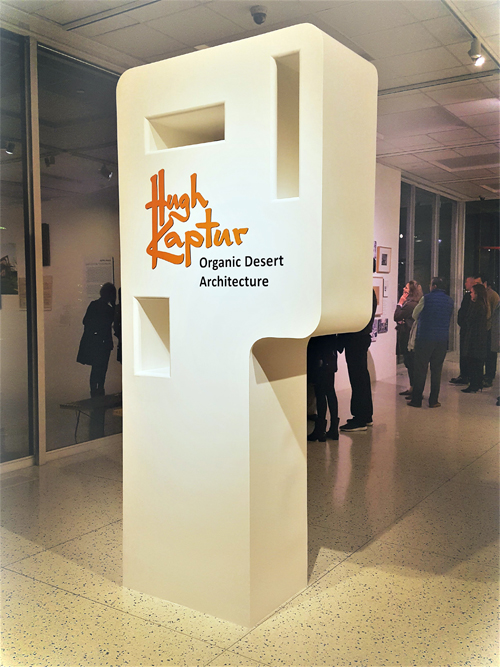
PSPF was proud to be the Lead Sponsor of the Palm Springs Art Museum Architecture and Design Center’s exhibition on the work of talented local modernist architect Hugh Michael Kaptur. This was the first museum exhibition of Kaptur’s work and included architectural drawings, models, slides, and other materials gifted to the museum by Kaptur in 2015. As part of PSPF’s sponsorship, PSPF underwrote free admission to the exhibition for more than 3,000 appreciative visitors over the course of Modernism Week in February 2019.

On May 23, 2019 PSPF was informed that the Kaptur exhibition would be extended to July 7, 2019 (from the originally scheduled June 17, 2019 closing date). According to museum officials the decision was made because they “have had such a great response and attendance has been very consistent.”

IN THE MEDIA

Jun-Sep 2019 Palm Springs Art Museum Insight (“Spring Highlights”)
Spring 2019, Palm Springs Art Museum Insight (“Hugh Kaptur: Organic Desert Architecture”)
February 14-24, 2019, ModernismWeek.com (“Hugh Kaptur: Organic Desert Architecture”)
February 14-24, 2019, Modernism Week Program (“Hugh Kaptur: Organic Desert Architecture”)
January 16, 2019, Palm Springs Art Museum Insiders’ View (“Hugh Kaptur: Organic Desert Architecture”)
January 2019, Palm Springs Art Museum The Fold (“Organic Desert Architecture”)
November 2018, Palm Springs Life (“California Dreamin”)

KapturRight
Categories
Buildings to Watch

Alexander in Sunrise Park

Alexander Tract House in Sunrise Park - 252 North Sunset Way, Palm Springs, CA 92262 SUCCESS

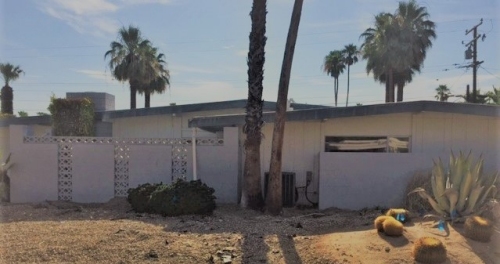
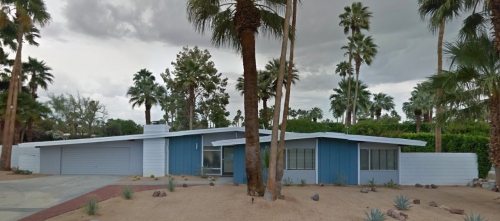
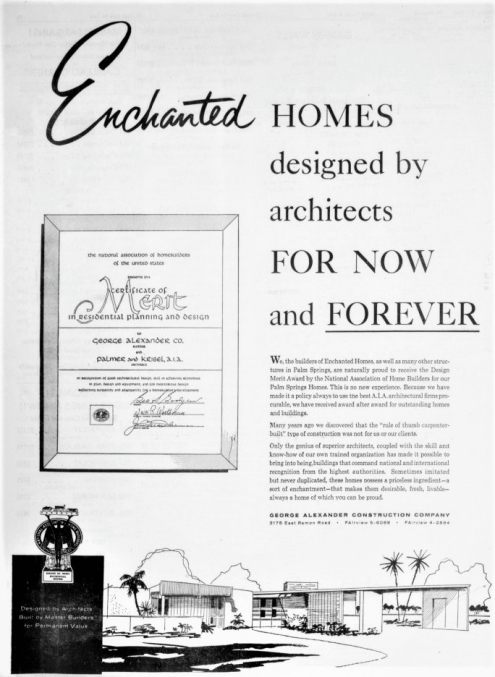
Built in 1958, this Alexander Construction Company (ACC) tract house was part of the Enchanted Homes development. The ACC product marries a Palmer & Krisel “Ramon Rise” floor plan with exterior elevation facade treatments done by a designer engaged by ACC partners George Alexander and Joe Dunas. This model was a popular design of the Enchanted Homes development and can be found on both the east (Sunmor) and west (Sunrise) sides of Farrell Drive.

In June of 2022, after its close brush with demolition and following an extensive renovation effort, property records show that the home sold for $1,875,000.

On July 18, 2017 PSPF board members Erik Rosenow and Jim Harlan met with city planning staff and neighborhood representatives to discuss possible paths forward for the protection of 252 North Sunset Way and the surrounding neighborhood of Alexander Construction Company-built tract homes.

On July 13, 2017 the house at 252 North Sunset Way was listed for sale.

On July 11, 2017 the HSPB voted unanimously to stay the demolition of 252 North Sunset Way. Making public comment in opposition to the demolition were nearby residents, representatives of neighborhood organizations and PSPF board members Erik Rosenow and Jim Harlan. Rosenow stated, “Speaking with many of Sunmor’s residents, the common thread is that they bought their homes in a…cohesive and well-preserved midcentury neighborhood…[and] are highly concerned about this demolition.”

On July 7, 2017 PSPF sent a letter to the city’s Historic Site Preservation Board (HSPB) strongly objecting to the proposed demolition of the Alexander Construction Company-built residence at 252 North Sunset Way. In the letter PSPF stated that, “All too frequently such demolitions lead to ill-advised new construction that is out of scale and out of character with the surrounding neighborhood. In short, the replacement is never as good as the original.” To read the PSPF letter click here.

252 North Sunset Way
A similar Alexander tract house design in the Sunmor neighborhood.
This Enchanted Homes advertisement appeared in the March 7, 1958 issue of the Desert Sun newspaper.

IN THE MEDIA

July 14, 2017, Desert Sun (Alexander in Sunrise Park)
July 12, 2017, KESQ (Alexander in Sunrise Park)

Categories
Buildings to Watch

Carnell Building

Carnell Building 184-196 North Palm Canyon Drive, Palm Springs, CA 92262

The following information about the Carnell Building is found in Desert Spanish: The Early Architecture of Palm Springs by PSPF board member Patrick McGrew: “As was the case with many moneyed Easterners, Julia Carnell [heiress to the National Cash Register fortune] often wintered in Palm Springs. In 1934, at the suggestion of local realtor Robert Ransom, Carnell acquired the site of the original First Community Church for $40,000 and built her first Palm Springs project, the Carnell Building. She chose Schenck & Williams, whose work she already knew from their Dayton projects for NCR, to design the building. This project introduced Harry Williams to the desert which would become his home, as well as the home of his sons Roger and Stewart. The property was designated a Class Two Historic Site to mark the location of the church that once stood on the site. Given the historic importance of the people involved, the Carnell Building could easily qualify as a Class One Historic Site. Unfortunate, but easily remedied alterations blunt the integrity of the original design.”

On October 6, 2014, and again on November 24, 2014, the city’s Architectural Advisory Committee approved a request to change the previously approved tile roofing material and tile stain pattern.

On July 22, 2013 the city’s Architectural Advisory Committee voted unanimously (7-0) to approve a Minor Architectural Application (MAA) for the “Reconstruction of the Second Floor Façade and Street-Front Clay Tile Roof Plane” of the Carnell Building. The approval was subject to conditions, i.e., it “must be fully waterproof” and that the applicant “work closely with staff to match colors and materials.”

On June 22, 2013 the city of Palm Springs’ Director of Planning Services reported that “plans had been submitted” to rebuild the historic Carnell Building’s burned-out second floor.
 
On August 22, 2012 the Desert Sun reported that the city staff obtained a permit to begin rebuilding the Carnell Building.
 
On the evening of July 11, 2012, PSPF board member Barbara Marshall made public comment at the city council meeting regarding the safety and security issues associated with the recent suspicious fires in vacant buildings in the downtown area.  
 
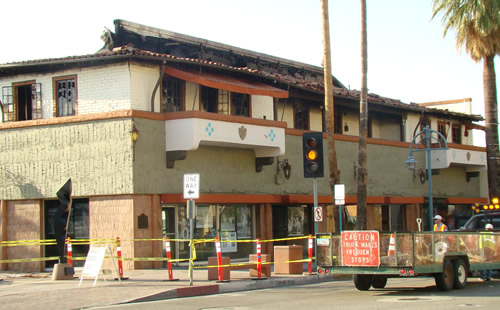
On July 11, 2012 an early morning fire at the Carnell Building at 184-196 North Palm Canyon Drive caused extensive second-floor damage to the structure. Later, the effort to bring the fire under control caused significant water damage to the first floor of the building.  Initially misreported by the media as a fire at the historic Town & Country Center (1948), the cause of the Carnell Building fire is under investigation.
carnell_building

IN THE MEDIA

August 22, 2012, Desert Sun (Carnell Building)

Categories
Buildings to Watch

Community Church of Palm Springs

Community Church of Palm Springs 283 South Cahuilla Road, Palm Springs, CA 92262

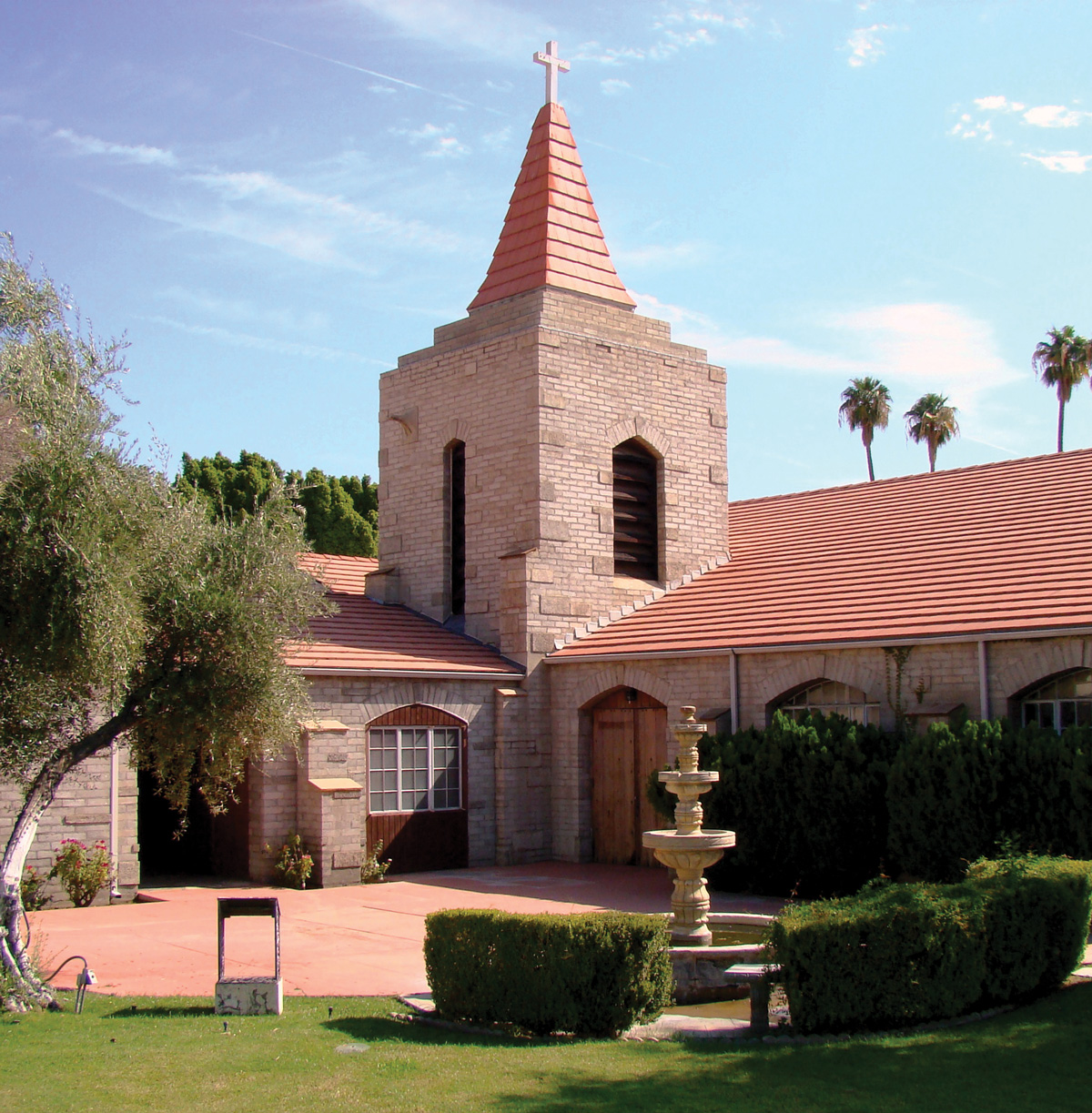
The Community Church of Palm Springs was designed by architect Charles Tanner in 1935. On February 21, 1954 President and Mrs. Eisenhower worshiped in the church during a week-long visit to Palm Springs. The church was designated a Class 1 historic site by the city of Palm Springs in 1989.

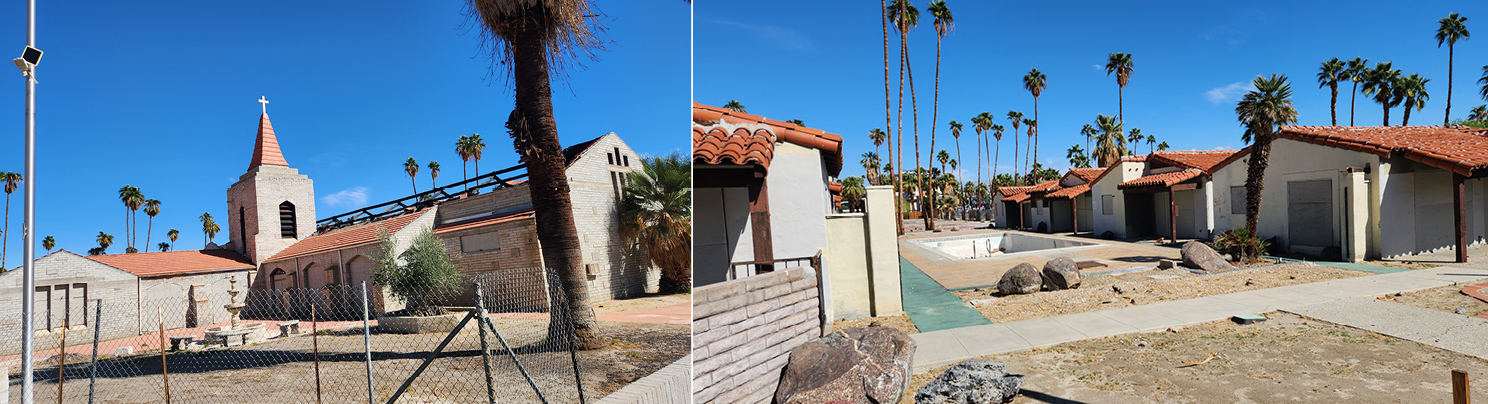
On April 23, 2025, after considerable discussion, the Palm Springs city council voted unanimously to approve yet another extension (described as a Hotel Operations Covenant Agreement) for what is referred to as the Orchid Tree Hotel project. The owner has revised the project to include construction of a three-story, approximately 72-room luxury hotel; restoration of the eight historic Orchid Tree bungalows into eight guest rooms; restoration of the historic Community Church into hotel services and restaurant; sixteen for-sale residential condominium units; gym and spa facilities; event space, administration support and back of house building, one new pool, and an exterior café/bar.

The city council’s approval included several conditions including on-site security, improved fencing, pest control, and graffiti removal. Several residents spoke during public comment and while they voiced support for the proposed project, they expressed frustration regarding the years of delays and continuing physical deterioration of the property. The owner’s Planning Application is due to the city on August 23, 2025.

On July 10, 2023, after years of delays and setbacks, the Palm Springs city council approved new terms for the project. Referred to as the Orchid Tree Hotel, the project was reportedly scheduled to break ground in October 2024. To read the KESQ news report click here.

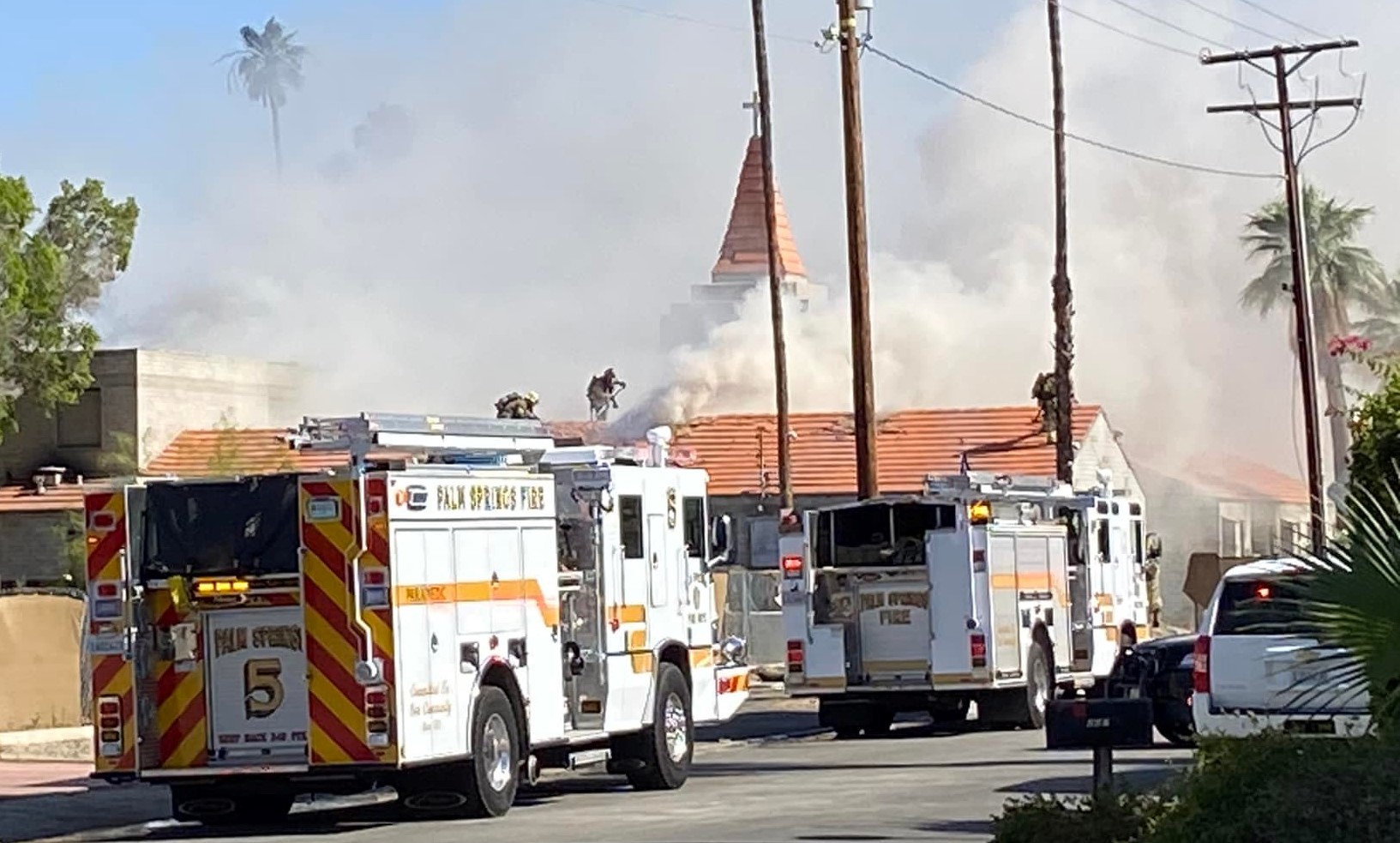
On April 28, 2022 another severe fire broke out at the Community Church of Palm Springs.

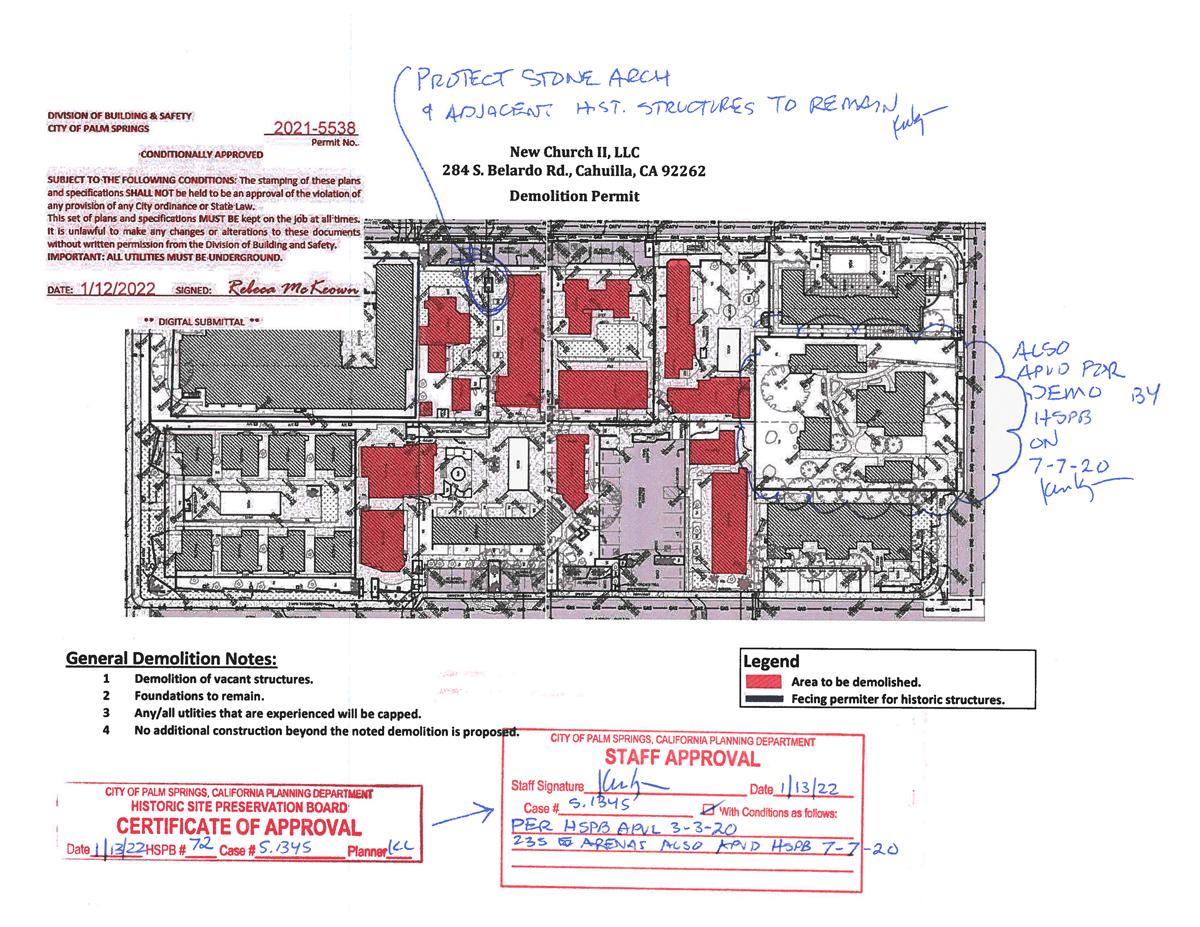
On April 20, 2022 demolition of the non-historic structures was underway.

On November 18, 2021 a Palm Springs city council staff report chronicled, in part, the protracted negotiations occurring between the city and the developer (including delays created by COVID).

On July 7, 2020 and March 3, 2020, the city’s Historic Site Preservation Board approved the demolition of non-historic structures at 239 West Arenas Road and 200 South Cahuilla Road as part of the proposed redevelopment and adaptive reuse of the Community Church and Orchid Tree Inn.

On November 8, 2016 the city’s Historic Site Preservation Board reviewed revisions to the previously approved applications for the repurposing of the Community Church and the Orchid Tree Inn to be combined and operated as one hotel with accessory commercial on an overall 3.1-acre site.

On May 17, 2014 at the city’s first celebration of National Preservation Month, the owner of the Community Church of Palm Springs announced his plans for the rehabilitation of the church and the adjacent Orchid Tree Inn. The next day the Desert Sun newspaper reported that the Community Church of Palm Springs “could rise from the ashes as a new luxury boutique hotel in the Historic Tennis Club neighborhood.”

On October 2, 2013, prompted by the Community Church of Palm Springs fire, PSPF President Erik Rosenow wrote a compelling “Valley Voice” which expressed concerns about the city’s non-existent enforcement of the Vacant Building ordinance. To read the Op-Ed piece click here.

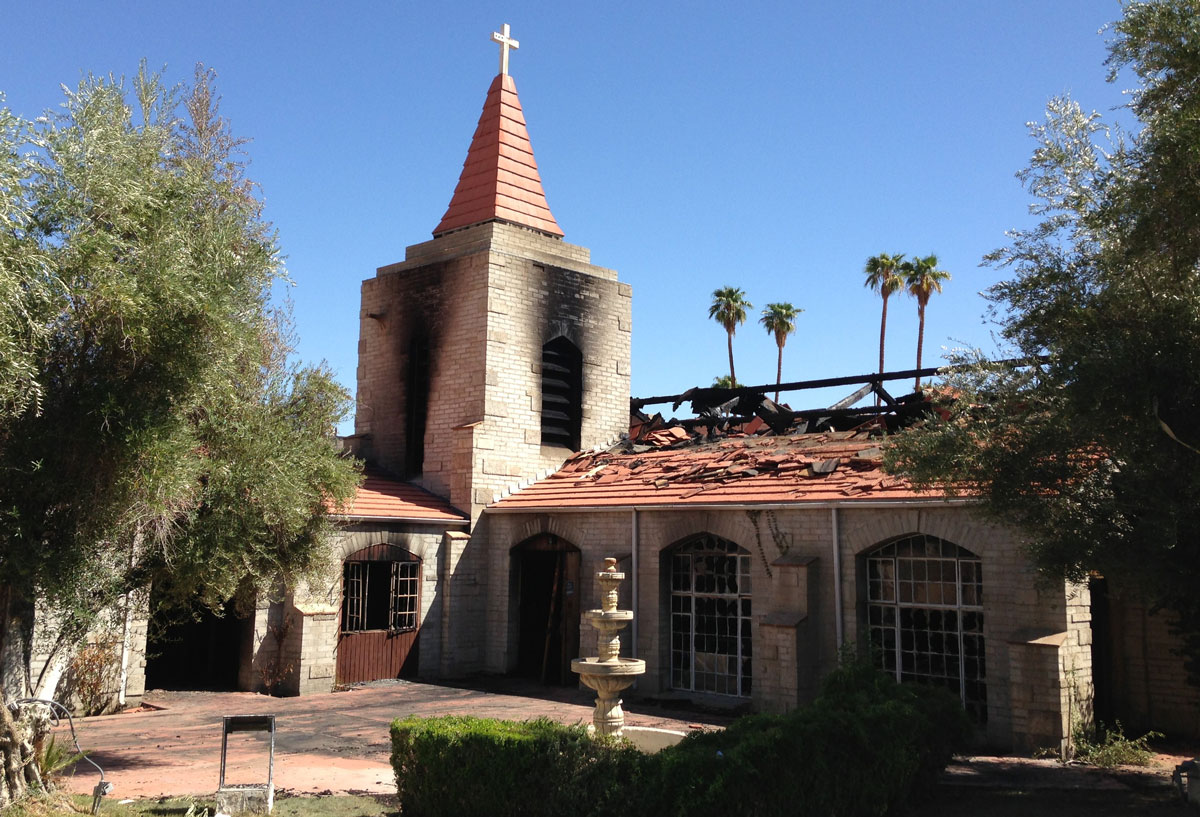
On September 18, 2013 the Community Church of Palm Springs was the victim of a severe fire. The church (featured on page 28 of PSPF’s Class 1: A Guide to the Designated Class 1 Historic Sites in Palm Springs booklet) had been vacant for many years. The Community Church fire occurred on the heels of two other suspicious fires in important buildings: the historic Chart House Restaurant building in Rancho Mirage and the Carnell Building on Palm Canyon Drive.

Palm Springs has suffered from a string of suspicious fires over the years that go as far back as the historic El Mirador Tower and Albert Frey’s Premier Apartments. We will keep you informed as developments on the Community Church fire unfold.

1-Community-Church-BMarshall
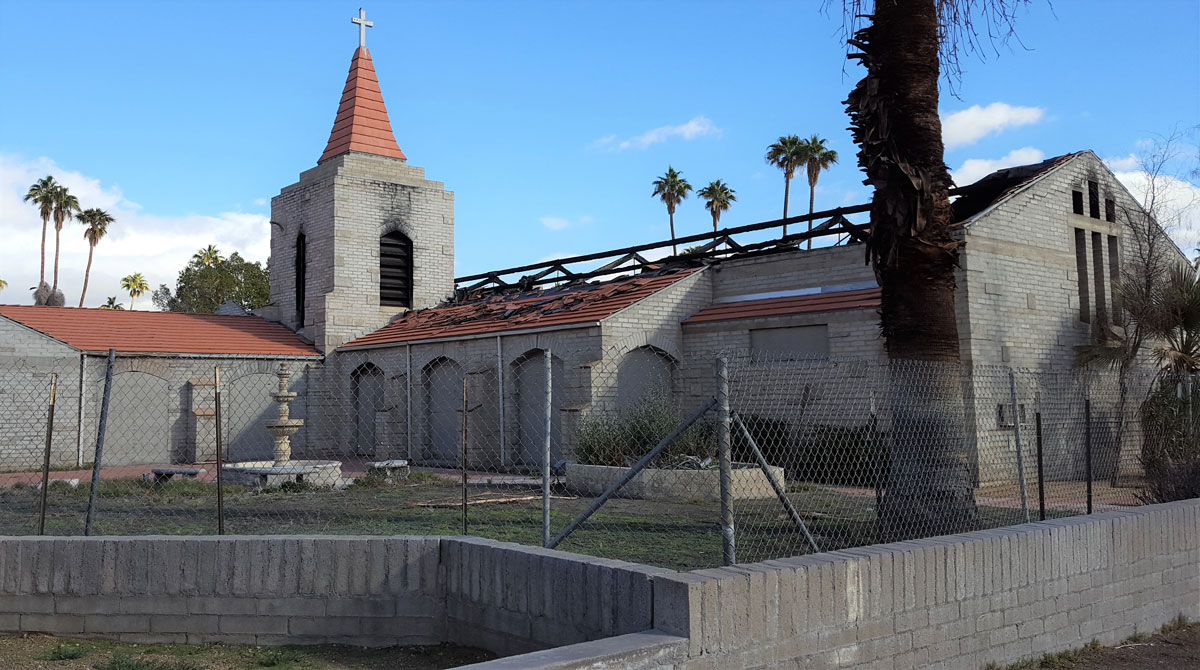
The Community Church and Orchid Tree Inn continue to suffer from neglect. (March 2025)
Fire on April 28, 2022
Demolition plan for non-historic structures. Courtesy City of Palm Springs
Community Church remains abandoned, January 11, 2017
Fire on September 18, 2013

IN THE MEDIA

November 8, 2023, Engage Palm Springs (Community Church)
July 13, 2023, KESQ (Community Church)
December 15, 2018, Desert Sun (Community Church)
December 4, 2013, Desert Sun (Community Church)

Categories
Buildings to Watch

Desert Magazine Building

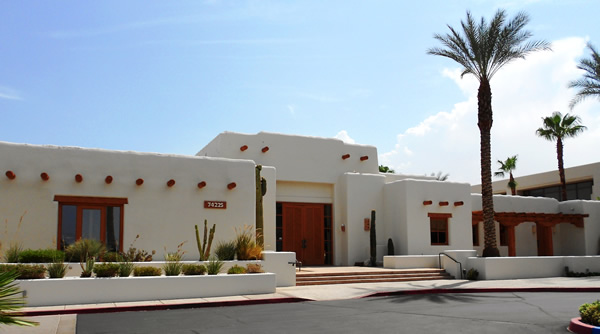
Desert Magazine Building - 74-225 Hwy. 111, Palm Desert, CA 92260 SETBACK

The Desert Magazine Building (1948), designed by architect Harry J. Williams, is a 17,000 square-foot building that housed the Desert Magazine and numerous other publications along with an art gallery, gift shop and gem shop. It was also the home of the Smoketree School of Desert Art. As the first commercial building to be built on the first developed block in the city of Palm Desert, it is arguably the city’s most historically important structure. Designed in the Pueblo-revival style, the building is still remarkably intact.

On August 23, 2012 the Palm Desert city council voted unanimously 5-0 to allow the destructive façade remodeling of the historic Desert Magazine Building despite compelling testimony by PSPF board member Ron Marshall and members of the city’s Cultural Resources Commission and local historical society. Citing various specious rationales for their incredibly shortsighted decision, the Palm Desert city council saw fit to sacrifice the city’s most historically important commercial building in deference to the whims of the current owner.

On August 13, 2012 PSPF sent a letter to the city manager of the city of Palm Desert stating that PSPF had been made aware of a proposed modification to the Desert Magazine Building and that “the unnecessary and arbitrary modification of this historic resource would be nothing short of a tragedy.” The letter also reminded the city of its legal obligations under the California Environmental Quality Act to critically evaluate projects which might cause substantial adverse change to an historic resource. Most importantly, the letter attached a “Historic Resource Evaluation Report” on the Desert Magazine Building prepared by PSPF board member Patrick McGrew. McGrew’s scholarly assessment of the architectural and historic importance of the Desert Magazine Building serves as compelling rationale for any alterations to the building to adhere to the Secretary of the Interior’s Standards for the Rehabilitation of Historic Structures.

Desert_Magazine_Bldg

IN THE MEDIA

January 26, 2017, Desert Sun (Desert Magazine Building)
August 24, 2012, Desert Sun (Desert Magazine Building)
August 23, 2012, Desert Sun (Desert Magazine Building)

Categories
Buildings to Watch

Greyhound Bus Terminal

Greyhound Bus Terminal 311 North Indian Canyon Drive, Palm Springs, CA 92262

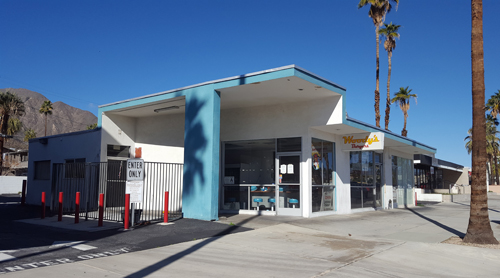
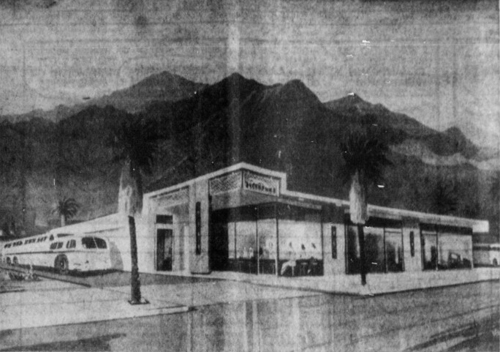
Designed by modernist architectural designer Howard Lapham in 1959, the Greyhound Bus Terminal (most recently Woody’s Burgers) is still remarkably intact. An architectural rendering of the bus terminal was published in the August 28, 1959 edition of the Desert Sun newspaper. Lapham arrived in Palm Springs in 1954 and over his career in the Coachella Valley he designed an impressive body of architectural work including dozens of commercial buildings (banks, hotels, restaurants, etc.) and large private residences.

The application for the project was eventually withdrawn.

On March 20, 2017 the city’s Architectural Advisory Committee voted to continue the project to a date uncertain “with direction to the applicant to further revise the application.”

On January 17, 2017 PSPF board member Ron Marshall made public comment before the Palm Springs Architectural Advisory Committee (AAC). During his comments, Marshall challenged the representatives from Zinque to “seize the opportunity” to preserve the Lapham-designed building and incorporate it into a new, more sensitive design. Marshall further opined that projects submitted as PDDs were obligated to provide a public benefit and that the historic preservation of the Greyhound Bus Terminal would partially compensate for the negative impacts of the Zinque Resort project (e.g., density, parking deficits, etc.). Two AAC representatives supported Marshall’s comments to the developer and one of the Zinque representatives called the preservation of the bus terminal “an interesting idea.”  The ACC voted to “continue to allow the applicant to address the Committee’s concerns.”

On December 20, 2016 North Palm Canyon Drive LLC submitted a Major Architectural (MAA) and Planned Development District (PDD) application for “The Zinque Resort,” a mixed-use hotel development located at 350 North Palm Canyon Drive. The development includes a 94-room hotel, restaurant, cocktail lounge, subterranean parking, etc., and will incorporate the façade of the art deco-style Simpson’s Radio & Frigidaire Shop (1937, Brewster & Benedict) at 342 North Palm Canyon Drive (a Class 1 Historic Site). Unfortunately, the Zinque Resort development currently contemplates the demolition of the modernist Greyhound Bus Terminal (1959, Howard Lapham) at 311 North Indian Canyon Drive.

GreyhoundBusStationBAMJan7
DesertSunGreyhound
Categories
Buildings to Watch

North Shore Yacht Club

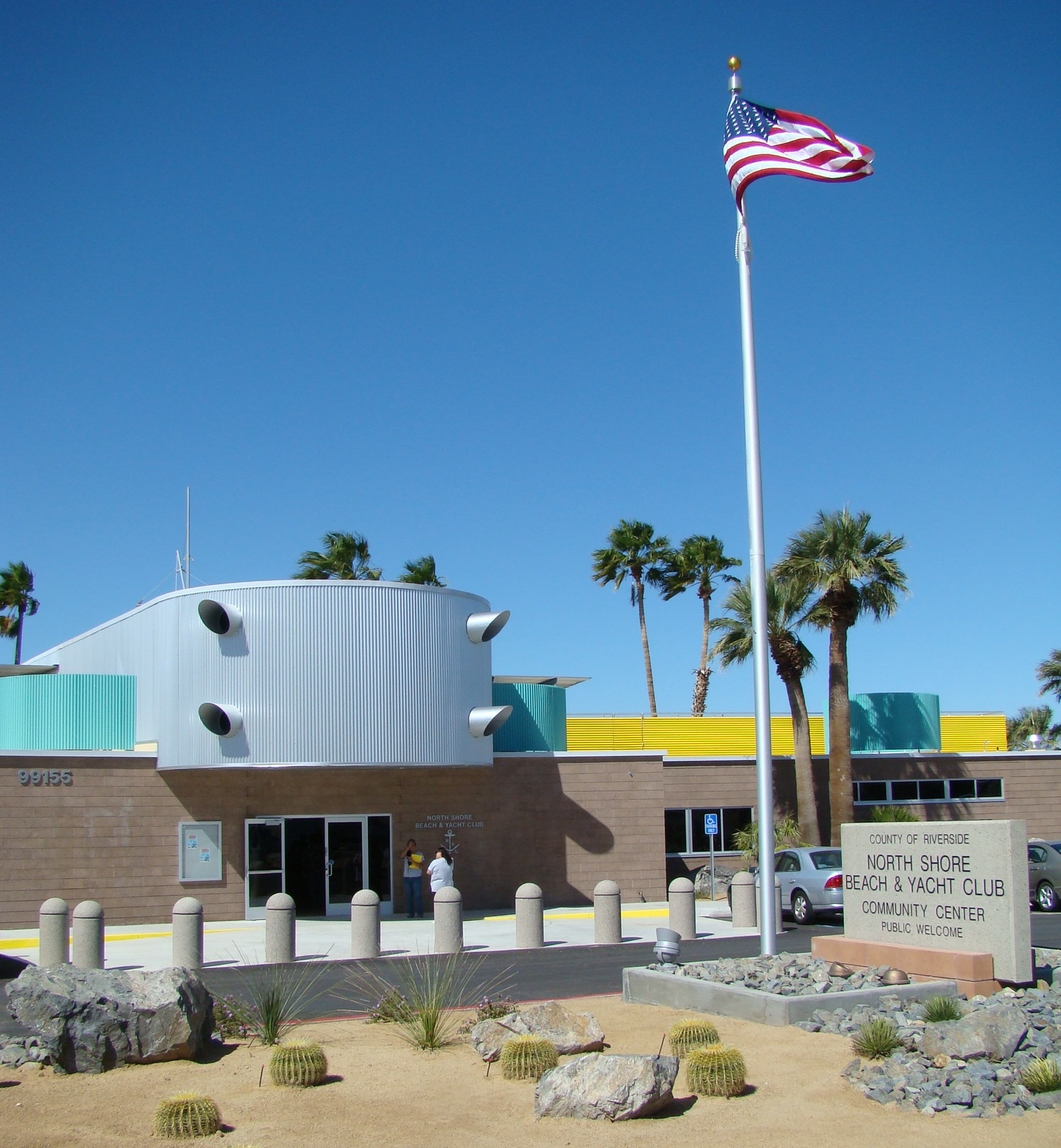
North Shore Yacht Club 99155 Sea View Dr, Mecca, CA 92254

On September 28, 2015 the North Shore Yacht Club was listed on the National Register of Historic Places. The property operates as a community center operated by the Desert Recreation District.

On May 18, 2011 PSPF board member Ron Marshall and volunteer John Rivera made public comment at the Riverside County Historical Commission meeting. In their comments, Marshall and Rivera emphasized the importance of keeping the first-rate rehabilitation of the North Shore Yacht Club “intact.”

In early May of 2011 PSPF was made aware of a Riverside County Economic Development Agency proposal to convert the second floor “Compass Room” of the North Shore Yacht Club (NSYC) into a teen center. The proposal removes the beautiful and architecturally striking suspended lobby stair, replaces it for a wider one, and adds a second stairway to the seaside exterior. Even more alarming, the proposal adds a lobby elevator which would take a huge bite out of the entry area and would rise through and above the second floor roof. These changes would drastically, and negatively, impact both the interior and exterior character of the historic building.

According to architect John Rivera, the Project Architect for the rehabilitation of the NSYC while at Holt Architects, “great pains” were taken to retain many of the original design elements of the yacht club. “There were reasons why we didn’t install an elevator then, all of which had to do with keeping the original design,” says Rivera, “and I seriously doubt that the same level of care would be taken this second time around. Given that there’s been such broad support and approval of the recent rehabilitation of the NSYC, it seems a crime to needlessly alter its iconic design now, for the mere purpose of a quick and cheap teen center…which will certainly prove its ill conception in a short time.”

If there is a valid need for a teen center to serve the North Shore community there are other (and possibly less expensive) building options on the NSYC site. For example, the rehabilitation of the yacht club’s “Bait Shop” for use as a teen center offers just one alternative. The rehab of this area would offer about the same square footage at a comparable cost when weighing the costs of a new elevator and new stair and the accompanying demolition and structural reconstruction. Yet another option is constructing an entirely new building to west of the NSYC, which could take advantage of the newly rehabbed restroom building. According to Rivera, “either of these two options would not only save the yacht club from unnecessary change, but would add a new facility that could provide multiple uses and be a win-win for all.”

Questions regarding this advocacy can be directed to:
PSPF volunteer John Anthony Rivera,  john.anthony.rivera@att.net or info@pspreservationfoundation.org.

NorthShoreYacht BMarshall
Categories
Buildings to Watch

Oasis Commercial Building

Oasis Commercial Building 101-121 South Palm Canyon Drive, Palm Springs, CA 92262

On July 17, 2009 PSPF wrote a letter to the Palm Springs city council supporting the Class 1 designation of the Oasis Commercial Building (1951), a modernist architectural gem designed by architect E. Stewart Williams. Additionally, PSPF worked with the Palm Springs Modern Committee to develop a “Consolidated Preservation Position,” which explained the importance of a Class 1 designation and pledged to work with the building owner to facilitate future sympathetic changes to the building.

On November 4, 2009 the Palm Springs city council voted 4-1 to bestow Class 1 historic status, “with modifications,” on the Oasis Commercial Building. Unfortunately, the terms of city council’s anemic designation allows the building owner (who has a track record of poor stewardship of the building) to sidestep Historic Site Preservation Board review of certain changes to the first floor of the building.

Due to our concerns about the unwise policy precedent set by the Palm Springs city council, and the potential for future abuse of this important historic resource, we have placed the Oasis Commercial Building on our “Buildings to Watch” page. We will continue to work to convince a future city council to grant full Class 1 historic site designation to this important building.

A brief description of the Oasis Commercial Building can be found on page 20 of our on-line Class 1 booklet.

oasis_image
Categories
Buildings to Watch

Shell Gas Station

Shell Gas Station 2796 North Palm Canyon Drive, Palm Springs, CA 92262

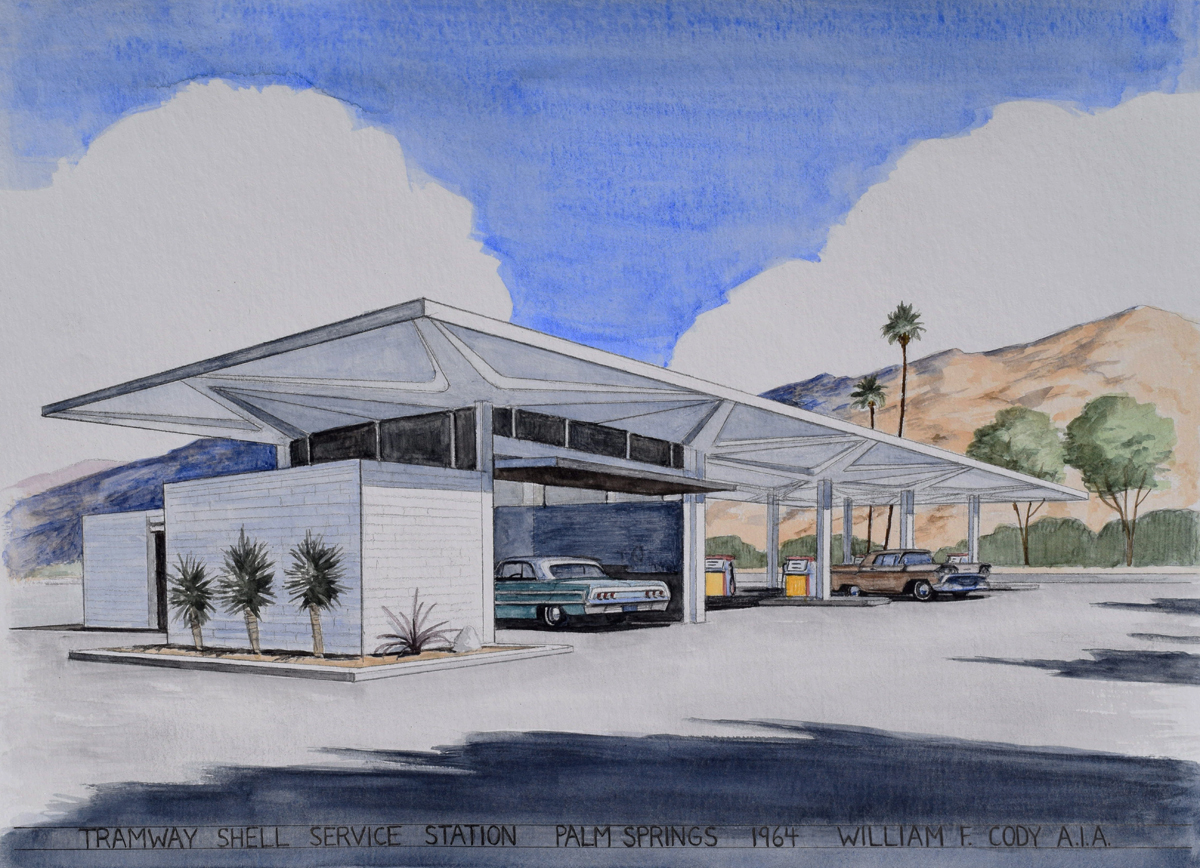
Until recently a Shell Gas Station, this commercial building was designed by architect William F. Cody in 1964. This is the last of five architect-designed midcentury gas stations in Palm Springs that is still operating as a gas station. In 2004, the gas station was included in Palm Springs’ city-wide historic resources survey. The survey opined that “the gas station appears to meet the level of significance necessary for individual National Register of Historic Places or California Register of Historical Resources eligibility.”

A sensitive rehabilitation of the gas station building was completed in 2019. Owner Sobhy Yousef was presented the Commercial Rehabilitation Award at the Palm Springs Modern Committee’s 2021 Annual Preservation Awards ceremony. During his remarks, Yousef took time to thank PSPF president Gary Johns for his advice and guidance during the rehabilitation process.

On January 4, 2017 the Palm Springs city council unanimously approved (5-0) the Class 1 Historic Site designation of the Shell Gas Station. PSPF board member Barbara Marshall made public comment before the city council stating, “we enthusiastically support the Class 1 historic designation of the William Cody-designed Shell Gas Station at 2796 North Palm Canyon Drive. It is the last of the midcentury architect-designed gas stations still functioning as such and is both a design and engineering marvel. Almost 50 years ago, in September of 1967, Palm Springs Life magazine published an article entitled ‘Garish Gas Stations? Not in Palm Springs’ which expounded on the architectural significance of the city’s non-corporate, architect-designed gas stations. In that article the author applauded how forward-thinking the city’s Planning Commission was. It set a standard that every commission since has tried to surpass…I’d like to applaud the efforts of…councilmember Mills, the Planning Department, specifically Director Flinn Fagg and city planner Ken Lyon. The city’s Historic Site Preservation Board, led by Gary Johns also did yeoman’s work on this designation as did citizens like Robert Imber and our sister organization the Palm Springs Modern Committee.”

On October 11, 2016 PSPF board member Barbara Marshall made public comment before the Palm Springs Historic Site Preservation Board in support of the Class 1 Historic Site nomination of the Shell Gas Station. Marshall stated PSPF’s support of the Architectural Resources Group (ARG) study which determined that there was substantive cause to proceed with the Class1 designation of the gas station. To read the ARG study click here.

On June 30, 2016 PSPF was informed by a Palm Springs city planning department representative the contract for professional services to investigate the historicity of the Shell Gas Station would be awarded to Architectural Resources Group “next week.”

On May 25, 2016 the Palm Springs Planning Commission heard the proposed modifications to the Cody-designed gas station. Making public comment on the issue was PSPF board member Gary Johns and PSModCom board members Jade Nelson, Robert Imber and Peter Blackburn. The Planning Commission deferred action on the item pending a determination as to whether or not the gas station qualifies as a Class 1 Historic Site.

On January 12, 2016 the Palm Springs Historic Site Preservation Board voted to “initiate a study pursuant to Municipal Code Section 8.05.135 (Investigation and Study) of the [Shell Gas Station] to inform the board of its possible historic significance.”

Background

On September 2, 2015 the Palm Springs city council upheld the PSModCom appeal of the Planning Commission’s June 10, 2015 approval decision and returned the matter to the commission for “consideration of all [of the] Historic Site Preservation Board recommendations.” This included the HSPB’s recommendation to initiate the Class 1 Historic Site designation process for the gas station.

On August 31, 2015 PSPF sent a letter to the city of Palm Springs supporting the PSModCom June 19th appeal letter. In the PSPF letter president Erik Rosenow asserted that, “The [Planning] commission’s decision was based on incomplete and incorrect information,” and further that “the owner’s proposal of additions and modifications to this building destroy the architectural fabric of this historically important structure and is patently short-sighted.” Additionally, PSPF included a copy of the September 1967 Palm Springs Life magazine article entitled “Garish Gas Stations? Not in Palm Springs” which explained the architectural significance of the city’s architect-designed gas stations. To read the PSPF letter click here.

On June 19, 2015 PSModCom appealed the Palm Springs Planning Commission’s conditional use permit (CUP) amendment asserting that the amendment “allows an addition to this historic building that would materially alter its historic significance,” and further that the “applicant misrepresented the project to the Planning Commission by repeatedly stating the project would not touch the Cody-designed building. This is not true; the west elevation of the Cody-designed building will be removed to provide wall-less, open interior space for tenant improvements.” To read the PSModCom letter click here.

On June 10, 2015 city staff provided an abbreviated synopsis of the HSPB’s recommendations to the Planning Commission. The commission then approved a conditional use permit which would have substantively altered the historic fabric of the Cody-designed gas station. Unfortunately, the commission did not receive all of the HSPB’s recommendations in the (incomplete) staff report (e.g., the HSPB recommended that the Architectural Advisory Committee review the proposed project, etc.).

On June 9, 2015 the city’s Historic Site Preservation Board reviewed the project, found it flawed on many levels, and provided numerous substantive comments to the Planning Commission.

On May 13, 2015 the Planning Commission heard the proposed changes to the Cody-designed gas station (i.e., “A Conditional Use Permit to Modify Floor Area to Provide Additional Retail Space at the Existing Gasoline Station Located at 2797 North Palm Canyon Drive’) and referred the matter to the city’s Historic Site Preservation Board.

According to Palm Springs city records, in June of 1996 the Planning Commission approved a revision to the original conditional use permit for a “467-sq. ft. retail space [addition].” Apparently, the requirements for this addition were never met and it was never realized.

According to Palm Springs city records, a building permit was issued in August of 1984 to “remodel and add 1,485-square feet” of retail space.

In September of 1967 Palm Springs Life magazine published an article entitled “Garish Gas Stations? Not in Palm Springs” which expounded on the architectural significance of the city’s non-corporate, architect-designed gas stations. To read the article click here.

Continue Reading

Courtesy Danny Heller
Shell-Gas-Station-Mar-2020-BAM-e

IN THE MEDIA

January 5, 2017, Desert Sun (Shell Gas Station)