Categories
Buildings to Watch

Greyhound Bus Terminal

Greyhound Bus Terminal 311 North Indian Canyon Drive, Palm Springs, CA 92262

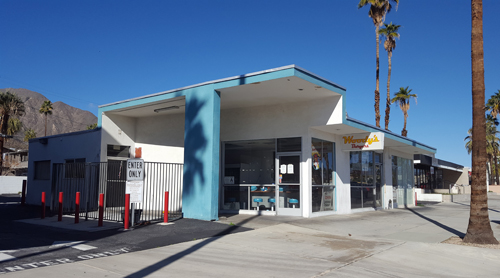
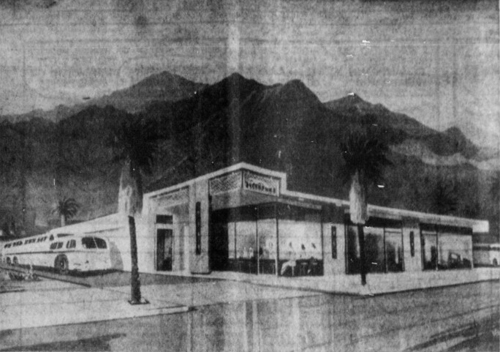
Designed by modernist architectural designer Howard Lapham in 1959, the Greyhound Bus Terminal (most recently Woody’s Burgers) is still remarkably intact. An architectural rendering of the bus terminal was published in the August 28, 1959 edition of the Desert Sun newspaper. Lapham arrived in Palm Springs in 1954 and over his career in the Coachella Valley he designed an impressive body of architectural work including dozens of commercial buildings (banks, hotels, restaurants, etc.) and large private residences.

The application for the project was eventually withdrawn.

On March 20, 2017 the city’s Architectural Advisory Committee voted to continue the project to a date uncertain “with direction to the applicant to further revise the application.”

On January 17, 2017 PSPF board member Ron Marshall made public comment before the Palm Springs Architectural Advisory Committee (AAC). During his comments, Marshall challenged the representatives from Zinque to “seize the opportunity” to preserve the Lapham-designed building and incorporate it into a new, more sensitive design. Marshall further opined that projects submitted as PDDs were obligated to provide a public benefit and that the historic preservation of the Greyhound Bus Terminal would partially compensate for the negative impacts of the Zinque Resort project (e.g., density, parking deficits, etc.). Two AAC representatives supported Marshall’s comments to the developer and one of the Zinque representatives called the preservation of the bus terminal “an interesting idea.”  The ACC voted to “continue to allow the applicant to address the Committee’s concerns.”

On December 20, 2016 North Palm Canyon Drive LLC submitted a Major Architectural (MAA) and Planned Development District (PDD) application for “The Zinque Resort,” a mixed-use hotel development located at 350 North Palm Canyon Drive. The development includes a 94-room hotel, restaurant, cocktail lounge, subterranean parking, etc., and will incorporate the façade of the art deco-style Simpson’s Radio & Frigidaire Shop (1937, Brewster & Benedict) at 342 North Palm Canyon Drive (a Class 1 Historic Site). Unfortunately, the Zinque Resort development currently contemplates the demolition of the modernist Greyhound Bus Terminal (1959, Howard Lapham) at 311 North Indian Canyon Drive.

GreyhoundBusStationBAMJan7
DesertSunGreyhound
Categories
Buildings to Watch

North Shore Yacht Club

North Shore Yacht Club 99155 Sea View Dr, Mecca, CA 92254

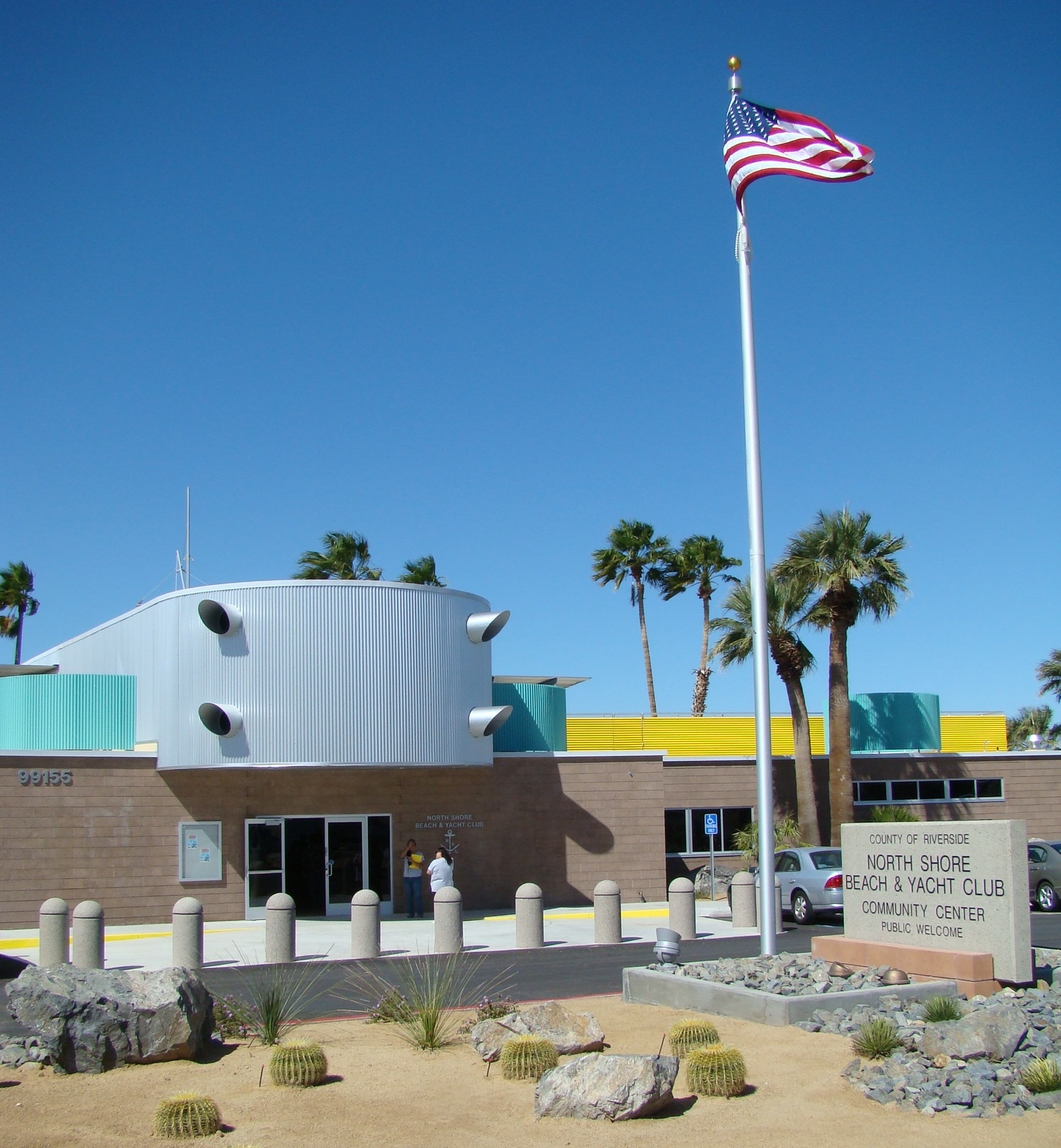
On September 28, 2015 the North Shore Yacht Club was listed on the National Register of Historic Places. The property operates as a community center operated by the Desert Recreation District.

On May 18, 2011 PSPF board member Ron Marshall and volunteer John Rivera made public comment at the Riverside County Historical Commission meeting. In their comments, Marshall and Rivera emphasized the importance of keeping the first-rate rehabilitation of the North Shore Yacht Club “intact.”

In early May of 2011 PSPF was made aware of a Riverside County Economic Development Agency proposal to convert the second floor “Compass Room” of the North Shore Yacht Club (NSYC) into a teen center. The proposal removes the beautiful and architecturally striking suspended lobby stair, replaces it for a wider one, and adds a second stairway to the seaside exterior. Even more alarming, the proposal adds a lobby elevator which would take a huge bite out of the entry area and would rise through and above the second floor roof. These changes would drastically, and negatively, impact both the interior and exterior character of the historic building.

According to architect John Rivera, the Project Architect for the rehabilitation of the NSYC while at Holt Architects, “great pains” were taken to retain many of the original design elements of the yacht club. “There were reasons why we didn’t install an elevator then, all of which had to do with keeping the original design,” says Rivera, “and I seriously doubt that the same level of care would be taken this second time around. Given that there’s been such broad support and approval of the recent rehabilitation of the NSYC, it seems a crime to needlessly alter its iconic design now, for the mere purpose of a quick and cheap teen center…which will certainly prove its ill conception in a short time.”

If there is a valid need for a teen center to serve the North Shore community there are other (and possibly less expensive) building options on the NSYC site. For example, the rehabilitation of the yacht club’s “Bait Shop” for use as a teen center offers just one alternative. The rehab of this area would offer about the same square footage at a comparable cost when weighing the costs of a new elevator and new stair and the accompanying demolition and structural reconstruction. Yet another option is constructing an entirely new building to west of the NSYC, which could take advantage of the newly rehabbed restroom building. According to Rivera, “either of these two options would not only save the yacht club from unnecessary change, but would add a new facility that could provide multiple uses and be a win-win for all.”

Questions regarding this advocacy can be directed to:
PSPF volunteer John Anthony Rivera,  john.anthony.rivera@att.net or info@pspreservationfoundation.org.

NorthShoreYacht BMarshall
Categories
Buildings to Watch

Oasis Commercial Building

Oasis Commercial Building 101-121 South Palm Canyon Drive, Palm Springs, CA 92262

On July 17, 2009 PSPF wrote a letter to the Palm Springs city council supporting the Class 1 designation of the Oasis Commercial Building (1951), a modernist architectural gem designed by architect E. Stewart Williams. Additionally, PSPF worked with the Palm Springs Modern Committee to develop a “Consolidated Preservation Position,” which explained the importance of a Class 1 designation and pledged to work with the building owner to facilitate future sympathetic changes to the building.

On November 4, 2009 the Palm Springs city council voted 4-1 to bestow Class 1 historic status, “with modifications,” on the Oasis Commercial Building. Unfortunately, the terms of city council’s anemic designation allows the building owner (who has a track record of poor stewardship of the building) to sidestep Historic Site Preservation Board review of certain changes to the first floor of the building.

Due to our concerns about the unwise policy precedent set by the Palm Springs city council, and the potential for future abuse of this important historic resource, we have placed the Oasis Commercial Building on our “Buildings to Watch” page. We will continue to work to convince a future city council to grant full Class 1 historic site designation to this important building.

A brief description of the Oasis Commercial Building can be found on page 20 of our on-line Class 1 booklet.

oasis_image
Categories
Buildings to Watch

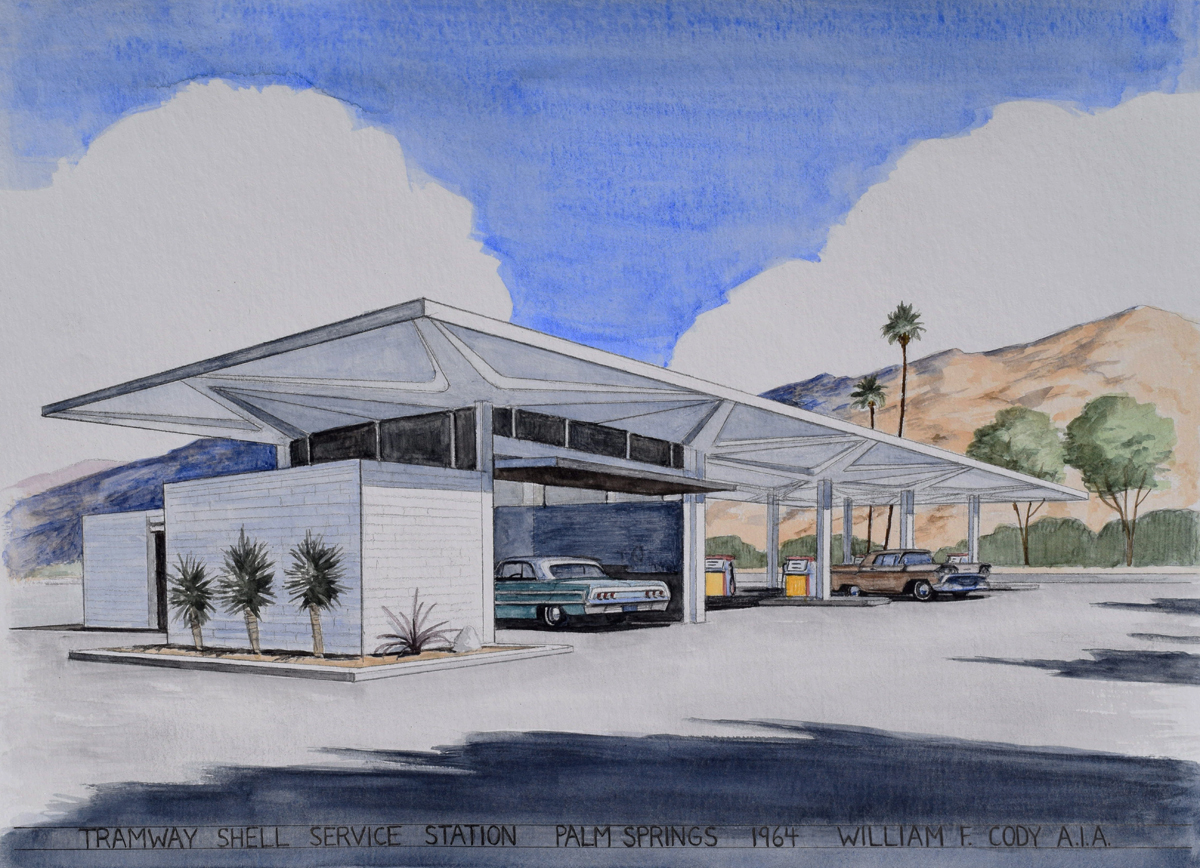
Shell Gas Station

Shell Gas Station 2796 North Palm Canyon Drive, Palm Springs, CA 92262

Until recently a Shell Gas Station, this commercial building was designed by architect William F. Cody in 1964. This is the last of five architect-designed midcentury gas stations in Palm Springs that is still operating as a gas station. In 2004, the gas station was included in Palm Springs’ city-wide historic resources survey. The survey opined that “the gas station appears to meet the level of significance necessary for individual National Register of Historic Places or California Register of Historical Resources eligibility.”

A sensitive rehabilitation of the gas station building was completed in 2019. Owner Sobhy Yousef was presented the Commercial Rehabilitation Award at the Palm Springs Modern Committee’s 2021 Annual Preservation Awards ceremony. During his remarks, Yousef took time to thank PSPF president Gary Johns for his advice and guidance during the rehabilitation process.

On January 4, 2017 the Palm Springs city council unanimously approved (5-0) the Class 1 Historic Site designation of the Shell Gas Station. PSPF board member Barbara Marshall made public comment before the city council stating, “we enthusiastically support the Class 1 historic designation of the William Cody-designed Shell Gas Station at 2796 North Palm Canyon Drive. It is the last of the midcentury architect-designed gas stations still functioning as such and is both a design and engineering marvel. Almost 50 years ago, in September of 1967, Palm Springs Life magazine published an article entitled ‘Garish Gas Stations? Not in Palm Springs’ which expounded on the architectural significance of the city’s non-corporate, architect-designed gas stations. In that article the author applauded how forward-thinking the city’s Planning Commission was. It set a standard that every commission since has tried to surpass…I’d like to applaud the efforts of…councilmember Mills, the Planning Department, specifically Director Flinn Fagg and city planner Ken Lyon. The city’s Historic Site Preservation Board, led by Gary Johns also did yeoman’s work on this designation as did citizens like Robert Imber and our sister organization the Palm Springs Modern Committee.”

On October 11, 2016 PSPF board member Barbara Marshall made public comment before the Palm Springs Historic Site Preservation Board in support of the Class 1 Historic Site nomination of the Shell Gas Station. Marshall stated PSPF’s support of the Architectural Resources Group (ARG) study which determined that there was substantive cause to proceed with the Class1 designation of the gas station. To read the ARG study click here.

On June 30, 2016 PSPF was informed by a Palm Springs city planning department representative the contract for professional services to investigate the historicity of the Shell Gas Station would be awarded to Architectural Resources Group “next week.”

On May 25, 2016 the Palm Springs Planning Commission heard the proposed modifications to the Cody-designed gas station. Making public comment on the issue was PSPF board member Gary Johns and PSModCom board members Jade Nelson, Robert Imber and Peter Blackburn. The Planning Commission deferred action on the item pending a determination as to whether or not the gas station qualifies as a Class 1 Historic Site.

On January 12, 2016 the Palm Springs Historic Site Preservation Board voted to “initiate a study pursuant to Municipal Code Section 8.05.135 (Investigation and Study) of the [Shell Gas Station] to inform the board of its possible historic significance.”

Background

On September 2, 2015 the Palm Springs city council upheld the PSModCom appeal of the Planning Commission’s June 10, 2015 approval decision and returned the matter to the commission for “consideration of all [of the] Historic Site Preservation Board recommendations.” This included the HSPB’s recommendation to initiate the Class 1 Historic Site designation process for the gas station.

On August 31, 2015 PSPF sent a letter to the city of Palm Springs supporting the PSModCom June 19th appeal letter. In the PSPF letter president Erik Rosenow asserted that, “The [Planning] commission’s decision was based on incomplete and incorrect information,” and further that “the owner’s proposal of additions and modifications to this building destroy the architectural fabric of this historically important structure and is patently short-sighted.” Additionally, PSPF included a copy of the September 1967 Palm Springs Life magazine article entitled “Garish Gas Stations? Not in Palm Springs” which explained the architectural significance of the city’s architect-designed gas stations. To read the PSPF letter click here.

On June 19, 2015 PSModCom appealed the Palm Springs Planning Commission’s conditional use permit (CUP) amendment asserting that the amendment “allows an addition to this historic building that would materially alter its historic significance,” and further that the “applicant misrepresented the project to the Planning Commission by repeatedly stating the project would not touch the Cody-designed building. This is not true; the west elevation of the Cody-designed building will be removed to provide wall-less, open interior space for tenant improvements.” To read the PSModCom letter click here.

On June 10, 2015 city staff provided an abbreviated synopsis of the HSPB’s recommendations to the Planning Commission. The commission then approved a conditional use permit which would have substantively altered the historic fabric of the Cody-designed gas station. Unfortunately, the commission did not receive all of the HSPB’s recommendations in the (incomplete) staff report (e.g., the HSPB recommended that the Architectural Advisory Committee review the proposed project, etc.).

On June 9, 2015 the city’s Historic Site Preservation Board reviewed the project, found it flawed on many levels, and provided numerous substantive comments to the Planning Commission.

On May 13, 2015 the Planning Commission heard the proposed changes to the Cody-designed gas station (i.e., “A Conditional Use Permit to Modify Floor Area to Provide Additional Retail Space at the Existing Gasoline Station Located at 2797 North Palm Canyon Drive’) and referred the matter to the city’s Historic Site Preservation Board.

According to Palm Springs city records, in June of 1996 the Planning Commission approved a revision to the original conditional use permit for a “467-sq. ft. retail space [addition].” Apparently, the requirements for this addition were never met and it was never realized.

According to Palm Springs city records, a building permit was issued in August of 1984 to “remodel and add 1,485-square feet” of retail space.

In September of 1967 Palm Springs Life magazine published an article entitled “Garish Gas Stations? Not in Palm Springs” which expounded on the architectural significance of the city’s non-corporate, architect-designed gas stations. To read the article click here.

Continue Reading

Courtesy Danny Heller
Shell-Gas-Station-Mar-2020-BAM-e

IN THE MEDIA

January 5, 2017, Desert Sun (Shell Gas Station)

Categories
Buildings to Watch

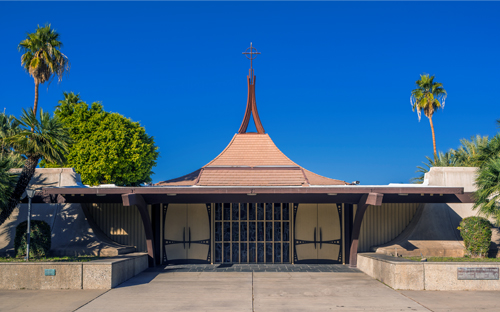
St. Theresa Catholic Church

St. Theresa Catholic Church 2800 Ramon Road, Palm Springs, CA 92264

St. Theresa Catholic Church (1968, William F. Cody) is considered one of architect Cody’s masterworks. Cody was an enthusiastic parishioner of the church and reportedly expended much time and creative effort on the commission. The church is in remarkably original condition and many of the interior elements designed by Cody remain intact.

On September 9, 2016 the PSPF board of directors voted unanimously to grant a historic preservation award of $5,000 to St. Theresa Catholic Church to help defray “the costs associated with the recently completed rehabilitation of the church’s exterior concrete and wood trim.” To read the PSPF grant letter click here.

On June 1, 2016 PSPF advisor Susan Secoy-Jensen met with a church representative and provided him with U.S. Department of the Interior Preservation Briefs 6 and 15 (“Dangers of Abrasive Cleaning” and “Preservation of Historic Concrete”).

On May 17, 2016 PSPF sent a letter to St. Theresa Catholic Church expressing the foundation’s concern about the apparent plan to paint the sanctuary. In the PSPF letter, the disadvantages of painting integrally tinted historic concrete were explained and an offer was made to have a preservation architect consult with the church at PSPF’s expense. To read the PSPF letter click here.

On May 15, 2016 a PSPF member contacted the foundation to express concern that the St. Theresa Catholic Church might be considering painting the main sanctuary. The member’s concern was prompted by a series of paint samples appearing on the side of the building.


Courtesy John Lewis Marshall
StTheresaPaint
Categories
Buildings to Watch

The Racquet Club

The Racquet Club 2743 North Indian Canyon Drive, Palm Springs, CA 92262

Started by actors (and tennis enthusiasts) Charlie Farrell and Ralph Bellamy in 1934, the Racquet Club was a modest enterprise consisting of only a snack bar and two tennis courts. However, from the beginning, the Racquet Club attracted the residents of the nearby movie colony. Early visitors included Humphrey Bogart, Errol Flynn, Lana Turner and others. With the building of the Racquet Club swimming pool in 1935, the club’s expansion was underway. The dining room was enlarged in 1937 and again in 1951. In 1946, 35 cottages were built along the banks of Netcher’s Creek (which winds through the club’s grounds). More cottages were added in 1956 to accommodate the increasing numbers of visitors to the club. Probably the most succinct history of the creation of the Racquet Club appears in the 1960-61 Annual Pictorial edition of Palm Springs Life magazine in an article entitled “The Racquet Club: Movie Colony Hideaway.”

On January 28, 2021 the Racquet Club was designated a Class 2 historic site by the Palm Springs city council.  The following buildings and structures are “contributing” features to the historic significance of the Racquet Club: (1) the Tennis Court, (2) the Main Pool, (3) the Schiff Residence, (4) one of the Frey-designed bungalows, and (5) portions of the Clubhouse that contain the Bamboo Room and Bogert Dining Room.

On October 6, 2020, upon review of an updated analysis, the HSPB determined that the property is more appropriately considered eligible for designation as a Class 2 historic site.

On October 10, 2017 the HSPB voted unanimously to recommend that the city council designate the Racquet Club as a Class 1 historic site.  The city council public hearing was postponed at the request of the property owner.

On June 21, 2017 the item was re-noticed due to a noticing error.

On May 17, 2017 the city’s Historic Site Preservation Board voted unanimously to recommend that the city council designate the Racquet Club as a Class 1 historic site.

On July 23, 2014 a significant portion of the historic Racquet Club fell victim to a suspicious fire. Presciently, the Racquet Club was identified as an endangered historic property in a PSPF letter to the mayor of Palm Springs on October 10, 2013. In that PSPF letter, the Racquet Club was named #2 in the foundation’s list of top 5 properties potentially in danger of fire or demolition by neglect. The PSPF letter also pointed out that the city’s lax enforcement of the Vacant Building ordnance had helped create the conditions that has led to these fires. To read the PSPF letter click here.

Vintage postcard circa 1955
Courtesy Palm Springs Historical Society
Categories
Buildings to Watch

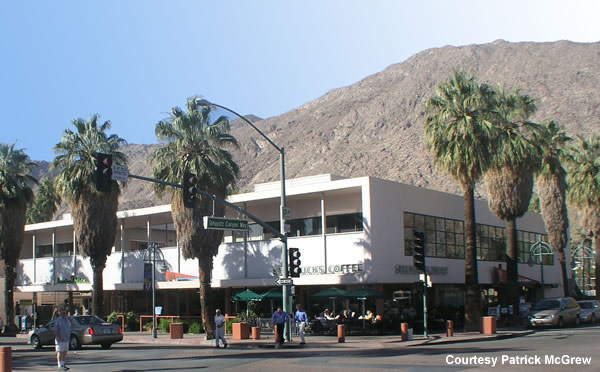
Town & Country Center

Town & Country Center 146-174 North Palm Canyon Drive, Palm Springs, CA 92262

The Town & Country Center (1948) was designed by two internationally-famous architects, Paul R. Williams and A. Quincy Jones. The Town & Country Center is one of the best examples of the international-style of architecture in southern California and is an important early “mixed-use” development. It is also architecturally noteworthy for its pedestrian-friendly courtyard.

Paul R. Williams is historically important as the AIA’s first African-American architect (1923) and first African-American AIA Fellow (1957).

On June 10, 2026, the Palm Springs City Council’s meeting agenda included a public hearing on “approval of a purchase and sale agreement” for a significant portion of the Town & Country Center. Many members of the community, including preservationists, fire fighters, and even a former city council member, spoke in support of the purchase. Among the speakers in support of the purchase was PSPF board member Barbara Marshall who reminded the city council that the present owner objected to the T&CC’s listing on the National Register of Historic Places and hence its status was being held in a state of “administrative abeyance.” Marshall argued that upon purchase the city should immediately and formally support the listing and that such an action on the part of the city would symbolically recognize the importance of the T&CC. In a letter of support for the purchase PSPF board advisor Susan Secoy Jensen stated, “Please carefully consider the new design being proposed for the Fire Station. We must not fall short of a continued legacy of good design that is timeless. We deserve better than many of the new projects being constructed in the city.” To read Secoy Jensen’s letter click here. Ultimately, after some discussion, the city council voted unanimously to proceed with the purchase. To read the city staff report, which provides rationale for the 4-million-dollar purchase, click here.

On April 8, 2026 (and again on April 22nd, May 12th, and May 27th), the Palm Springs City Council met in Closed Session to discuss a “Real Property Negotiation” to purchase important portions of the historic Town & Country Center. In each instance the city attorney announced “no reportable action.”

In February of 2024, build-out of a local boba bar chain restaurant was completed.

During April and May of 2023, positive improvements to the facade and entryway of the Town & Country Center continued (including new concrete flatwork).

Significant improvements to the Palm Canyon Drive facades of the Town & Country Center continued into early 2023.

During late 2022, significant improvements to the Palm Canyon Drive facades of the Town & Country Center were undertaken.

The E. F. Hutton Building (1955, Wexler & Harrison) underwent a rehabilitation in early 2022 which included the polishing of the exterior black terrazzo walls and the interior green terrazzo floors. The project was in support of a “pop-up” shop catering to the Modernism Week 2022 crowd.

On April 20, 2020 the city’s Architectural Advisory Committee (AAC) met, and unanimously approved, Phase 1 of the plan to rehabilitate the historic Town & Country Center. Making public comment in enthusiastic support of the project were PSPF president Gary Johns and PSPF board member Barbara Marshall. Both Johns and Marshall commended preservation architects Jim Cioffi and Susan Secoy Jensen for the authenticity of their proposed rehabilitation. AAC Chair Tom Jakway pithily characterized the proposal as a “great plan.”

On March 3, 2020 the city’s Historic Site Preservation Board met to hear an item entitled “Grit Development Proposing Alterations to the Town & Country Center at 174 North Palm Canyon Drive (HSPB #51/Case 3.1780),” also known as “Phase 1 of the T&CC rehabilitation.” The proposal was presented by preservation architects Jim Cioffi and Susan Secoy Jensen. PSPF board member Ron Marshall made public comment stating, in part, that “The PSPF board is of the opinion that this Phase 1 plan is what we have advocated for more than a decade: a sympathetic and historically accurate rehabilitation. To make this plan even more notable, it actually restores some lost historical elements.” To read the HSPB Staff Report click here.

On March 2, 2020 at the PSPF board of directors meeting, the board was briefed by Jim Cioffi (principal, Cioffi Architect) and Susan Secoy Jensen (principal, Secoy Architects) on “Phase 1” of the Town & Country Center rehabilitation. The PSPF board members were impressed with the diligence of the architects in researching the history of the complex and their sincerity in ensuring that the T&CC rehabilitation was “done right.”

2019

On October 31, 2019 PS Resorts responded to PSPF’s request for a retraction of their assertion that PSPF was in support of the placement of the “Forever Marilyn” statue on the grounds of the historic Town & Country Center. To read the PS Resorts retraction click here.

On October 23, 2019 PSPF sent a letter to P.S. Resorts requesting a full retraction and apology for a P.S. Resorts Press Release which asserted that PSPF was in support of the placement of the “Forever Marilyn” statue on the grounds of the historic Town & Country Center.  Read the PSPF letter

In a July 23, 2019 letter to the city of Palm Springs the National Trust for Historic Preservation notes “…the Town & Country Center is one of Palm Springs’ iconic architectural assets that enhance the city’s sense of place…Because of the property’s legacy, the National Trust asks the City of Palm Springs city Council to seriously consider acquiring the site as part of an equitable remedy for Section 1090 violations currently under negotiation with Grit Development LLC.”  Read the National Trust letter

On July 10, 2019 PSPF board member Gary Johns made thoughtful and compelling public comment to the Palm Springs city council in favor of including the Town & Country Center in the ongoing California Code Section 1090 negotiations between the city and Grit Development.

On July 8, 2019 PSPF sent a letter to the Palm Springs city council which documented the PSPF advocacy that had appeared in the Desert Sun on June 30, July 6, and July 7, 2019. To read the letter click here.

On June 30, 2019 the Desert Sun newspaper published a “Your Voice” opinion piece by PSPF board member Gary Johns entitled “Include Town & Country Center in talks.” The opinion piece was an impassioned argument for the inclusion of the Town & Country Center in the California Code Section 1090 negotiations between the city and Grit Development. John’s pointedly asked “Why isn’t the T&CC in the mix? Why isn’t the city demanding it be in the mix?” Read the opinion piece

On June 18, 2019 PSPF sent a letter to the Palm Springs city council regarding the proposed settlement of its California Code Section 1090 claims against Palm Springs Promenade, LLC, inclusive of Grit Development, LLC (successor to John Wessman/Wessman Holdings), in connection with the redevelopment of the Desert Fashion Plaza. In the letter, PSPF recommended including the Town & Country Center in the negotiations stating that, “The current negotiations propose the donation of the “Boulders” and “Crescendo” properties…to the city of Palm Springs. We would strongly recommend that the city negotiate for the donation of the Town & Country Center either in addition to, or in lieu of, those properties. We submit that the T&CC is a far more important property to the community at large.” PSPF further opined, “This…would place the city in the enviable position of being able to sell the T&CC to a preservation-minded developer.” To read the PSPF letter click here.

2018

October 22, 2018 the city’s Downtown Project Standing Subcommittee (composed of councilmembers Middleton and Roberts) hosted a presentation by the architectural firm of Marmol Radziner (representing Grit Development) which unveiled a “rehabilitation” plan for the Town & Country Center. The plan proposed demolishing a significant portion of the complex’s historic fabric. As might be expected, the general public reaction to the proposal was highly skeptical. PSPF board member Steven Keylon made public comment on the plan reiterating many of the points made in his opinion piece published two days earlier.

On October 20, 2018 the Desert Sun newspaper published a “Your Turn” opinion piece by PSPF board member Steven Keylon entitled “Plan sacrifices too much of Town & Country Center of Palm Springs.” Keylon characterized the Grit Development proposal as “not a responsible ‘rehabilitation’ plan,” and further recommended that Grit Development “hire a qualified preservation architect…to help guide it through the master process.”  Read the opinion piece 2018

On September 25, 2018 PSPF board members Gary Johns, Steven Keylon, Erik Rosenow and PSPF advisor Susan Secoy Jensen were briefed by the architectural firm of Marmol Radziner on Grit Development’s proposed redevelopment “Master Plan” of the Town & Country Center. The verbal and power point briefing did not provide the PSPF attendees with any physical materials in the form of paper plans, renderings, etc. The general sense of the PSPF attendees was that a significant amount of the T&CC’s historic fabric (as identified by the city in its Class 1 Historic Site designation) was being proposed for demolition.

On July 31, 2018 the city of Palm Springs effectively denied PSPF’s Public Records Act request (aka Freedom of Information Act request) citing as rationale for withholding the requested documents as “attorney-client privileged information.” The small handful of documents provided to PSPF (totaling 29 pages) consisted of non-city originated documents and documents already posted on the city’s publicly accessible website.

On July 16, 2018 PSPF received an email from the city of Palm Springs regarding PSPF’s eminent domain FOIA request that stated “…it is anticipated that the City will need an additional 7 days to review and produce the documents.”

On May 18, 2018 PSPF responded to the city of Palm Springs with FOIA search terms in addition to “eminent domain” opining that, “While we recognize that staff resources are limited, responsiveness to FOIA requests are arguably one of the most tangible measures of a city government’s commitment to transparency.” To read the PSPF letter click here.

On May 15, 2018 the city of Palm Springs sent a letter to PSPF (in response to PSPF’s eminent domain FOIA request) that reported the city had “identified…responsive records.” Due to the potentially “voluminous” number of responsive documents, the city requested additional search terms and informed PSPF they would likely need “an additional 60 days to review and produce the documents.” To read the entire city letter click here.

On May 8, 2018 the Palm Springs Historic Site Preservation Board continued the previous month’s discussion regarding the re-painting of the T&CC. During the presentation the architectural firm of Marmol Radziner (representing the applicant Grit Development) presented a revised paint palette for the T&CC. Previous to the meeting, on May 4, 2018, PSPF board member Steven Keylon had sent a letter to the HSPB identifying a number of historical inaccuracies in the Marmol Radziner proposal. To read Keylon’s letter, which provided detailed recommendations (based on vintage Kodachrome slides), click here. After the HSPB meeting, Keylon agreeably discussed his recommended changes with the applicant’s representative and other interested parties. Of additional note, the city’s Planning Director Flinn Fagg stated “…in doing some further discussion with the applicant, they are in the process of doing a structural study and so what I’m proposing as a condition of approval, to follow up on what you had recommended last month, is that by January of 2019 they [the applicant] submit the structural study to us [the HSPB].”

On April 10, 2018 the city of Palm Springs’ Historic Site Preservation Board met to discuss an application for a Certificate of Approval (Case #3.1780) by Grit Development (represented by the firm of Marmol Radziner) to paint and make “minor exterior repairs” to the Town & Country Center (T&CC). Leo Marmol characterized the repaint and removal of selected non-historic elements as an effort “to improve the current appearance of the existing buildings…so we are not here to present a rehabilitation project.” In an April 9, 2018 letter to the HSPB, PSPF board member Steven Keylon opined that “the paint colors proposed [by the applicant] are from a later repaint and are not the original paint scheme.” The applicant indicated that just a day prior to the HSPB hearing an undisturbed area of the T&CC (as revealed under a piece of vintage signage) confirmed Keylon’s opinion, thereby preventing an historic “mis-paint.” To read Keylon’s letter click here. Several HSPB members expressed their frustration with the slow pace of progress regarding the repair and rehabilitation of the T&CC. In response, Marmol told the HSPB that “this process will not be a fast process.” HSPB member Bill LaVoie stated that the repaint was “premature” and that the T&CC “needs to be stabilized, not repaired…so that it doesn’t continue to fall apart in the next five years.” LaVoie further opined “basically we’re putting make-up on something that needs a facelift, we’re just spackling it and we’re hiding the mistakes rather than making an honest effort in the eventual restoration of this building.” HSPB Chair Gary Johns pointed out that Grit Development’s recent announcement of delays to the progress of the downtown development (specifically the delayed construction of the Virgin Hotel) could possibly push out the rehabilitation of the T&CC another two years. The Certificate of Approval was granted with a number of conditions.

On April 4, 2018 PSPF sent a California Freedom of Information Act (FOIA) request to the city of Palm Springs for all documents regarding “eminent domain” dating back to January 1, 2008. The FOIA request intends to document the city’s previously aggressive pursuit of eminent domain for the Wessman downtown parcel and address the city council’s recent “amnesia” about the merit of such a course of action for the Town & Country Center.

On February 16, 2018 PSPF president Erik Rosenow spoke during the Palm Springs Walk of Stars dedication of architect Paul R. Williams’ commemorative star. In his comments, which were enthusiastically received, Rosenow emphasized the importance of a proper and sensitive rehabilitation of the T&CC and encouraged the city of Palm Springs to pursue their right of eminent domain of the historic property.

PSPF and Modernism Week partnered to produce and display an oversized storyboard chronicling the history of PSPF’s advocacy for the T&CC. The display at “CAMP” was seen by thousands of Modernism Week 2018 attendees.  Read the storyboard

2017

On August 1, 2017 PSPF’s Quarterly 2-2017 newsletter (item #1) stated “As our members know, the Town & Country Center (T&CC) has languished under the current owner for more than 15 years. Last year, during the T&CC’s Class 1 Historic Site designation proceedings, the owner proposed an unsympathetic plan to demolish historic fabric to accommodate a hotel on the site. It is now PSPF’s view that the city of Palm Springs should pursue its right of ’eminent domain’ over the historic property. In such a scenario, the city would be required to pay for the property. Fortunately, should recent corruption allegations prove true, it opens the door for the city to ‘claw back’ monies paid to the developer to facilitate the scandal-plagued downtown development. While the current city leadership seems conflicted about such a course of action we expect this idea, and the opportunities it presents, to gain momentum.”

In a July 26, 2017 letter to the city of Palm Springs, the PSPF attorney stated that PSPF “formally requests that the City exercise its constitutional power of eminent domain to acquire the property [i.e., the Town & Country Center] and begin its rehabilitation.” To read the entire three-page legal opinion click here.

On March 20, 2017 the Desert Sun newspaper ran an opinion piece entitled “Town & Country Center a Vital Bridge to Future Downtown.” The editorial, written by PSPF vice president Gary Johns, explained how a restored Town & Country Center would “connect the downtown and the tribe’s burgeoning projects; not with a street, but with heart and soul.” To read the Op-Ed piece click here.

On March 15, 2017 PSPF board members Steven Keylon and Steven Price made public comment before the Palm Springs city council. Both Keylon and Price encouraged the council to consider pursuing the eminent domain process for the Town & Country Center. Mayor Moon queried the city attorney about the possibility of eminent domain. Unfortunately, the city attorney gave an ambiguous answer implying it was not a possibility for the T&CC (even though the city had previously pursued eminent domain for the entire downtown parcel).

On March 12, 2017 the Desert Sun newspaper ran an opinion piece entitled “What PS Council Should Do About Town & Country.” The editorial, written by PSPF board member Barbara Marshall, eloquently expounded on the next steps that should be taken by the Palm Springs city council. Among Marshall’s suggestions were, (1) that the city council pursue eminent domain proceedings, (2) that the city council direct the city staff to start enforcing the Vacant Building ordinance (contained in Chapter 8.80 of the Palm Springs municipal code), and (3) that individual councilmembers use their influence to push Wessman Development to sell the T&CC to a developer with preservation experience. To read the Op-Ed piece click here.

On February 28, 2017 the Desert Sun newspaper published an above the fold article entitled “Preservationists to Developer Wessman: Sell Shopping Mall.” In the article, both PSPF advisor Susan Secoy Jensen and PSPF board member Ron Marshall were quoted extensively. Marshall told the newspaper, “The best case scenario would be that the Town & Country Center will be sold to another developer, hopefully one that specializes in historic preservation.” To read the entire article click here.

On February 27, 2017 the Palm Springs city council held a “Study Session to Discuss Moving Forward Palm Springs Development Projects, Including the Downtown Revitalization.” Many individuals spoke in support of a restored Town & Country Center.

2016

On April 20, 2016 PSPF’s Class 1 Historic Site nomination for the Town & Country Center (T&CC) was approved (4-1) by the Palm Springs city council. Speaking on behalf of the designation were PSPF board members Erik Rosenow, Ron Marshall, Steven Price, Barbara Marshall, Tracy Beckmann (who read comments submitted by preservationist Beth Edwards Harris) and PSPF advisor Susan Secoy-Jensen. PSModCom representatives Chris Menrad and Jade Nelson also spoke in support of the nomination. In an email to the membership, PSPF stated, “Although many hurdles still remain until the ultimate rehabilitation of the T&CC, the PSPF membership should be strongly encouraged by this major preservation success.”

On April 9, 2016 PSPF sent a letter to the city of Palm Springs’ Director of Planning Services amending the Town & Country Center Class 1 Historic Site nomination to include the landscape architecture (a suggestion made by the HSPB on March 8) and other minor items. To read the PSPF letter click here.

On March 8, 2016 the Palm Springs Historic Site Preservation Board met to consider the Class 1 Historic Site nomination prepared by PSPF. Making public comment in support of the nomination was PSPF board member Ron Marshall and PSPF advisor Susan Secoy Jensen. Commenting on the nomination, Marshall said that Secoy-Jensen, “has authored an extraordinary nomination which recognizes the Town & Country Center as a ‘campus’ of important buildings.” The HSPB approved the Class 1 nomination unanimously with minor conditions.

On January 30, 2016 the Desert Sun newspaper featured an article entitled, “Wessman offers to save, restore Town & Country Center.” In the article, Michael Braun (senior vice president of Wessman Development) is quoted as saying, “In the spirit of working with the community and the council, we are now exploring options with the goal to preserve most of the architecturally significant buildings… It also has become apparent that the majority of the current council is in favor of an adaptive reuse of the Town Country versus demolition.” PSPF board member Ron Marshall is quoted in the article as saying, “We [PSPF] remain skeptical that Wessman has the in-house expertise to do a first-rate rehabilitation of the T&CC,” and further that, “We believe that the brightest future for the T&CC is to attract a developer that specializes in historic preservation projects.”

On January 12, 2016 PSPF informed the city of Palm Springs’ Historic Site Preservation Board that the Town & Country Center nomination had been submitted. The HSPB asked to place discussion of the nomination on their February agenda.

On January 11, 2016 PSPF re-submitted the Class 1 Historic Site nomination for the Town & Country Center to the city of Palm Springs. The 34-page nomination was ably prepared by architect and PSPF advisor Susan Secoy Jensen. The PSPF board of directors made the decision to resubmit the T&CC nomination after the newly-elected Palm Springs city council indicated it might be receptive to supporting such an action.

On January 6, 2016 the Palm Springs city council conducted a study session on the Downtown Specific Plan. PSPF board member Ron Marshall made public comment appealing to the city council to remove the Town & Country Center (Block K) from the plan and move to acquire the property by eminent domain. Marshall also informed the city council of PSPF’s plan to soon resubmit the Town & Country Center’s Class 1 Historic Site nomination to the city’s Historic Site Preservation Board. In closing, Marshall stated “Let’s move forward to return the Town & Country Center to the community.”

2015

On December 12, 2015 PSPF sent a letter to Palm Springs Mayor Moon which forwarded the PSPF letter of November 7, 2015 to the Planning Commission. Importantly, the PSPF cover letter stated that “the foundation will soon re-submit the Class 1 Historic Site nomination for the T&CC to the city’s Historic Site Preservation Board for subsequent hearing by the city council. This will afford the current city council the opportunity to finally remedy the leadership failures of previous city councils.” To read the cover letter click here.

On November 12, 2015 the Planning Commission met for over six hours addressing a host of issues concerning the downtown Specific Plan. Public concerns centered around sidewalk widths, view corridors, building heights, etc., with members of the public generally expressing dissatisfaction with the emerging project. PSPF board member Steven Price made public comment concerning the historic preservation of the T&CC.

On November 7, 2015 PSPF sent a letter to the Palm Springs Planning Commission in anticipation of their November 12, 2015 meeting to discuss changes to the “Museum Market Plaza Specific Plan.” In the letter PSPF opined, “It is our view that the developer, who owns the historic Town & Country Center, has already been accommodated to excess and at the expense of significant public funds. Hence, a compelling argument can be made that the historic preservation of the T&CC is an overdue and reasonable quid pro quo for those concessions previously granted to the developer. Granting yet additional major concessions to the developer (especially those regarding height) is a political decision that should be made independent of the fate of the T&CC.” To read the entire PSPF letter click here.

On October 13, 2015 the Palm Springs Historic Site Preservation Board (HSPB) recommended that the city council amend the Specific Plan to retain the Town & Country Center. The HSPB rationalized their request by pointing out that the Town & Country Center had recently been determined eligible for both the state and national registers.

On Friday, August 7, 2015 the National Register nomination for the Town & Country Center (T&CC) was heard by the California State Historical Resources Commission in Sacramento. The commission voted unanimously to make the T&CC “eligible” for listing on both state and national registers. Notably, the T&CC nomination received 13 letters of support (including the Paul R. Williams Project, the Palm Springs Modern Committee, Modernism Week, the California Preservation Foundation and many prominent individuals). The Sacramento hearing was attended by three PSPF board members, including the nomination’s author Susan Secoy Jensen, Jim Harlan and Tracy Beckmann. In her public comment before the commission Beckmann explained, “In recent years we [PSPF] have concluded that it is absolutely critical to our advocacy efforts to separate the T&CC from the drama of local politics and short-sighted development schemes. Hence, the foundation’s application before you has a very simple but important purpose…to finally have the historic and architectural significance of the T&CC reviewed authoritatively and objectively. Your approval of our submission will go far in convincing the public that the T&CC is not just the passion of a few individuals, but rather a unique and irreplaceable historic resource that should be preserved for generations to come.” To read the Paul R. Williams Project letter click here.

2014

On December 31, 2014 PSPF asked that the California State Historic Preservation Office consider adding the Town & Country Center to the California State Register (and by extension the National Register) of Historic Places. Accompanying the request was a scholarly 59-page application authored by PSPF board member and architect Susan Secoy-Jensen. Although owner (i.e., Wessman Development Company) support is required for addition to these registers, even if the owner doesn’t support the designation, the property can still receive a “determination of eligibility.” This allows the current (or future) owner the ability to endorse the designation sometime in the future and immediately place it on the California and National Registers of Historic Places. The PSPF board considered “determination of eligibility” status for the T&CC significant for several reasons. Most importantly, such status will make the T&CC more attractive to outside (or partnering) developers, especially those who specialize in the rehabilitation of historic properties. (Note: The full 59-page submission to the California SHPO has been edited to 35 pages for brevity).

On February 5, 2014 the Palm Springs city council approved 4-1 (with Pougnet, Hutcheson, Foat and Lewin supporting) an amendment to the city’s historic preservation ordinance expanding the definition of a “Class 3” Historic Site from pre-1945 buildings to all buildings built before 1969. This amendment now extends Class 3 protection to the city’s 1945 to 1968 building stock (including the 1948 Town & Country Center) and requires that any requests for a demolition permit be reviewed by the city’s Historic Site Preservation Board. The passage of the amendment was assumed to be a perfunctory legislative matter until a “minor addition” to the amendment was proposed by a council member. The proposed addition specifically excluded already approved projects, like the approved city plan to run a “road to nowhere” through the Town & Country Center, and was an undisguised attempt to invalidate the protection that would be afforded to the T&CC as a Class 3 building. The ensuing spirited and lengthy debate ultimately rebuffed the attempt to exclude the T&CC from the Class 3 category. In a February 6, 2014 email to the membership PSPF opined, “This minor victory is significant insofar as there is increasing momentum for the rehabilitation of the T&CC in many community circles. While the appreciation for the architectural importance of the T&CC has been building for years, more and more individuals, and groups, are coming to the realization that the success of the downtown revitalization may be in jeopardy if it depends solely on a new hotel and a handful of shopping mall tenants. In short, an architectural “attraction,” like the T&CC, could provide the added diversity essential to the success of the downtown revitalization.” Previously, on December 2, 2013 PSPF sent a letter to the city enthusiastically endorsing the expansion of the Class 3 site definition. To read the PSPF letter click here.

In the February 2014 issue of Desert Magazine, PSPF board advisor Tracy Conrad wrote an article entitled “Swanky Banks.” In her article, Conrad describes how the T&CC inspired the designers of other commercial buildings to reach new creative heights. To read the article click here.

In the January 2014 issue of Desert Magazine, PSPF board advisor Tracy Conrad wrote an article entitled “From Soulful to Sexy: How the Town & Country Center Helped Shape the Area’s Modern Architecture Movement.” In her article, Conrad describes how the collaboration of T&CC architects Paul R. Williams and A. Quincy Jones dramatically influenced the course of desert modernism. To read the article click here.

2013

On October 10, 2013 in response to Palm Springs Mayor Pougnet’s request that the “preservation foundation” identify five endangered historic buildings, PSPF sent a letter that cautioned “oversimplifying” the issue of vacant historic buildings in the city. PSPF called for a “strategic, rather than reactive” approach to this complex issue. The letter stated that it was PSPF’s view that the sheer number of historic buildings (over 200) coupled with the non-existent enforcement of the city’s Vacant Building ordinance demanded a more thoughtful and longer-term solution. PSPF also pointed out that it had met with senior city staff a year ago to express concerns over the lack of enforcement of the Vacant Building ordinance. Finally, in response to the mayor’s specific request, PSPF identified five endangered buildings with the Town & Country Center at the top of the list. To read the PSPF letter click here.

On October 2, 2013 PSPF President Erik Rosenow wrote a compelling “Valley Voice” column about the future of the Town & Country Center. In the column, Rosenow applauds the city’s renewed interest in enforcing the Vacant Building ordinance and warns that unless pro-active measures are taken the Town & Country Center could fall victim to a suspicious fire like other Palm Springs landmarks. To read the Op-Ed piece click here.

2012

On October 21, 2012 PSPF delivered a letter to the Palm Springs city manager which stated that, “For the past decade we have watched the historic Town & Country Center…slowly deteriorate through neglect under the current owner. We are now at the point where a decade of deferred maintenance is starting to take a serious physical toll on the structure.” The letter included 22 photographs documenting the poor condition of the building and asserted that the owner of the building was “in serious breach of both the letter and intent of the…ordinance.”  Read the PSPF letter and photographic survey

On October 18, 2012 PSPF board members (Messrs. Williams, Johns, McGrew and Marshall) met with city staff to discuss the city’s implementation of the Vacant Building ordinance.

On October 15, 2012 PSPF conducted a photographic survey of the Town & Country Center (limited to the exterior ground-level) to document what were believed to be numerous violations of the Vacant Building ordinance (Chapter 8.80 of the Palm Springs Municipal Code).

On September 9, 2012 PSPF sent a letter to the Palm Springs city manager reporting that transients had taken up residence in the historic Town & Country Center. The letter documented previous examples of the owner failing to secure the building and asked the city to “take more aggressive enforcement actions to remedy this problem.” To read the PSPF letter click here.

2011

On June 26, 2011 PSPF board member Patrick McGrew wrote an insightful “Valley Voice” column about the future of the Desert Fashion Plaza and the Town & Country Center. To read the Op-Ed piece click here.

On June 17, 2011 the city of Palm Springs issued a news release that stated, in part, that “Wessman Development has agreed to remove the Town and Country Center from the Desert Fashion Plaza Revitalization Plan.”

At the June 15, 2011 Palm Springs city council meeting, PSPF board members and volunteers made public comment asking the council to remove the Town & Country Center from Wessman Development’s Desert Fashion Plaza Revitalization Plan. The PSPF speakers emphasized the compatibility of both revitalizing the Desert Fashion Plaza and restoring the Town & Country Center.

On June 12, 2011 PSPF board member Gary Johns wrote a “Valley Voice” column for the Desert Sun newspaper that addressed the benefits of historic preservation and how the rehabilitation of the Town & Country Center would benefit the community. To read the Op-Ed piece click here.

On June 9, 2011 PSPF delivered the Sustainability Assessment for the Preservation of the Town & Country Center prepared by Ecotype Consulting, Inc. In the cover letter to the mayor and city council PSPF wrote, “We’re sure you would agree that our common commitment to sustainability implicitly includes a commitment to green redevelopment. With the rehabilitation of the T&CC, the city of Palm Springs would become the leader in green development throughout the Coachella Valley.” To read the PSPF cover letter click here. Read the sustainability assessment.

On June 8, 2011 PSPF sent a letter to the Palm Springs mayor and city council detailing the PSPF concerns about the proposed Development Agreement with Wessman Development. The site plan associated with the Development Agreement includes the demolition of the T&CC. The letter was an expanded version of PSPF’s May 2011 letter delivered to the Planning Commission. To read the PSPF letter click here.

On May 25, 2011 in a well-considered and principled decision, the city’s Planning Commission voted 3-1 (with two recusals) to reject the proposed “Development Agreement” with Wessman Development. The decision sent a clear message that the commissioners viewed the Town & Country Center as an historic asset that should be rehabilitated. The commissioners voiced concerns about the associated Wessman site plan including lack of green space and poor traffic management. One commissioner characterized as “lop-sided” the lucrative benefits proposed for the developer under the Development Agreement. At the Planning Commission meeting yet another site plan (aka a “Revitalization Plan”) was presented. To see the Desert Sun’s graphic of that plan click here.

On May 19, 2011 PSPF delivered a letter to the city’s Planning Commission that asserted that it was PSPF’s view “that the inclusion of the Town & Country Center (T&CC) in the proposed [Wessman Development] plan and Development Agreement before you is flawed on many levels and fails to comport with the values and priorities of the city’s general plan, historic resources program and sustainability program.” The 8-page letter is an excellent overview of the issues surrounding the T&CC controversy. To read the PSPF letter click here.

On May 18, 2011 Mr. Sanford Garner, president of the National Organization of Minority Architects, wrote a letter to the mayor regarding his recent trip to Palm Springs and his visit to the T&CC. In his letter president Garner expressed his concern that the city was pursuing a development plan that included the demolition of the T&CC and stated that the current Wessman Development plan was not consistent with the city’s “highly-publicized sustainability campaign.” President Garner also contended that “the historical importance of Paul R. Williams cannot be overstated.”  Read NOMA president’s letter

On May 11, 2011 PSPF board members Gary Johns and Ron Marshall (and PSModCom board member Chris Menrad) met with the museum’s executive leadership (Harold Matzner and Harold Meyerman) to voice concerns about the museum’s support for the current Wessman Development Desert Fashion Plaza Concept Plan which will demolish the historic Town & Country Center and the Wexler-designed E. F. Hutton Building.

On May 5, 2011 the board of the Palm Springs Preservation Foundation voted unanimously to accept a proposal from Ecotype Consulting to conduct a “Town & Country Center Sustainability Study.” Ecotype Consulting is a highly-regarded local firm from Redlands, California that has real-world experience coupled with academic credentials. The study should be completed by the end of June, in time to inform decisions about the fate of the historic Town & Country Center. The completed study will be distributed to the Palm Springs city council and other interested city boards and commissions.

On April 29 and 30, 2011 PSPF hosted an educational advocacy visit by Mr. Sanford Garner, the president of the National Organization of Minority Architects (NOMA). On Saturday April 30 Mr. Garner (who has significant experience in the field of preservation architecture) toured the Town & Country Center with PSPF board members Patrick McGrew and Gary Johns. After the tour Mr. Garner commented that the Town & Country Center was “an historic resource that other cities would envy.”  Watch the Video

On April 11, 2011 PSPF contacted the city manger to report that “squatters” had taken up residence on the first floor of the Town & Country Restaurant (most recently Zelda’s nightclub) in the historic Town & Country Center complex. PSPF expressed concern that this greatly increased the potential for damage and/or fire to the building and asked that the appropriate city departments take action.

On April 8, 2011 PSPF board members Patrick McGrew and Gary Johns accompanied architect Donald Wexler on a visit to the E. F. Hutton Building that, according to Johns, has been “hiding in plain sight” for years within the Town & Country Center. Designed by Wexler & Harrison in 1955, the building later housed the Palm Springs Club. The E. F. Hutton building will fall victim to demolition should the city council approve the owner/developer’s current plan for the Desert Fashion Plaza.

On April 5, 2011 PSPF board member Erik Rosenow wrote a “Valley Voice” column for the Desert Sun newspaper that addressed the Town & Country Center controversy. To read the Op-Ed piece click here.

On March 20, 2011 PSPF’s board of directors met with the board of directors of the Palm Springs Modern Committee to discuss the issue of the Town & Country Center. As a result, several joint PSPF/PSModCom subcommittees were formed to pursue various advocacy strategies.

On March 6, 2011 PSPF sent a letter to the Palm Springs Art Museum board of trustees asking for a meeting with the trustees to discuss the museum’s position on the Town & Country Center. To read the PSPF letter click here.

On March 2, 2011 the city council conducted a “public hearing/study session” ostensibly to “review and discuss the results of the community input and visioning sessions with [the] property owner.” After an overview of the publicly-derived “Preferred Concept Plan,” the developer was allowed to present a completely new “Wessman Development Desert Fashion Plaza Concept Plan.” While the new Wessman Development DFP Concept Plan is laudable insofar as it successfully breaks up the DFP superblock, it recycles the developer’s demand for the gratuitous demolition of the Town & Country Center in exchange for a new retail store frontage “road to nowhere.” Particularly disturbing was public comment by a senior Palm Springs Art Museum official characterizing the proposal as a “terrific plan” and implicitly endorsing the demolition of the Town & Country Center.  View the Wessman plan

On January 26, February 3 and February 9, 2011 the city of Palm Springs hosted three “visioning sessions” to receive public input regarding the Desert Fashion Plaza and the Town & Country Center. Many PSPF members and board members attended the sessions and were outspoken in their support for the restoration of the Town & Country Center. Public input also included calls for local (as opposed to chain) retail, pedestrian-friendly throughways, world-class architecture, etc. As a result of this community process a “Preferred Concept Plan” was developed that offered an innovative solution that addressed many of the shortcomings of the failed DFP superblock. The final community plan also disconnected the Town & Country Center from the DFP development plan, a short-term solution supported by PSPF. Despite this apparent real progress, at the final February 9, 2011 visioning session, Mayor Pougnet suddenly announced that the developer had agreed to “work with the city” and “had heard” the community’s input.

2010

On December 15, 2010, the Palm Springs city council voted 5-0 to proceed with plans to acquire both the Desert Fashion Plaza and Town & Country Center. The vote was the result of years of fruitless efforts by the city to motivate Wessman Development Company to have the properties contribute to the city’s economy. The vote also validated the preservation community’s strategic decision not to litigate on CEQA grounds when the Town & Country Center’s Class 1 historic site nomination was rebuffed by the city in June of 2009. The city has established a schedule for community input (“visioning” workshops) which will discuss the mechanics of purchasing the Wessman holdings which have been appraised at $15.7 million for the Desert Fashion Plaza and $2.3 million for the Town & Country Center. According to the mayor, the city may pay for the properties either through an agreement with another developer (via a Disposition and Development Agreement) or through a “tax assessment created by a vote of the people.”

2009

At the November 18, 2009 Palm Springs City council meeting, the Museum Market Plaza Specific Plan (which includes the historic Town & Country Center) was amended as follows: “No permit for the demolition or substantial alteration of any portion of the Town and Country Center will be issued until (a) all discretionary entitlements consistent with the Specific Plan have been approved for the renovation or redevelopment of the existing Desert Fashion Plaza; (b) building permits in furtherance of such renovation or redevelopment have been issued; and (c) substantial work consistent with such building permits have commenced on the existing Desert Fashion Plaza.”  

It is PSPF’s view that the foregoing amendment guarantees the safety of the T&CC for the immediate future as the current owner/developer has asserted he does not have the financial wherewithal to renovate the Desert Fashion Plaza.  Should the current owner/developer fail to renovate the Desert Fashion Plaza in a timely manner, we are confident that the city of Palm Springs will take legal action to acquire and renovate the T&CC.

On June 24, 2009 the Palm Springs City Council voted 5-0 AGAINST Class 1 historic site designation of the Town and Country Center despite significant public support and an endorsement from the State of California’s Office of Historic Preservation. We will keep you updated as the T&CC drama continues to unfold.  Read the CA OHP letter

Read our informational flyer 10 Myths and Misconceptions About the Town & Country Center and Historic Preservation. On June 18, 2009, PSPF volunteers delivered a copy of the 10 Myths flyer along with a cover letter to 200 Downtown Palm Springs Business Owners. To read the cover letter click here.

Background

Consistent with the city staff’s findings, on June 9, 2009 the city’s Historic Site Preservation Board voted 4-2 (DeLeeuw, Gilmer, Marshall and Williams supporting) recommending Class 1 historic site designation of the Town and Country Center (T&CC) to the city council.

The nomination was authored by PSPF board member Patrick McGrew and is a thoughtful and scholarly assessment of the historic and architectural merits of the property. The 21-page nomination has already injected some much-needed objectivity into the sometimes emotional T&CC debate.

Unfortunately, proponents of demolishing the T&CC have been swayed by the developer’s specious arguments that (1) the building is unremarkable, (2) it would be expensive to renovate and (3) it is not an economically viable business configuration.

These arguments, of course, are flawed. Any concerned citizen who reads the nomination will readily conclude that the building is historically and architecturally important. Secondly, renovation costs alluded to by the developer have been unrealistically high. Thirdly, we know that courtyard configurations have not only been viable in the past but are viable today (witness the success of “The Corridor” complex just a few blocks north of the T&CC).

The economic viability of our downtown is not some elusive goal. Historic preservation has worked to revitalize hundreds of downtowns all over the country. Many of these downtowns have fewer and far less remarkable architectural resources than Palm Springs. We need only to point these simple truths out to our fellow citizens and elected leaders.

Continue Reading

“Preserving Modernism: The Town & Country Center”

An entertaining film chronicling the fascinating story of the Palm Springs Preservation Foundation’s advocacy efforts to save the historic Town & Country Center. (15 min.)  Watch the Film

T&CC portions purchase CC 10Jun26 staff report
T&CC Feb2024 BMarshall
Courtesy Erik Rosenow
T&CC-Mar-2023-BMarshall-w
Courtesy Erik Rosenow
E. F. Hutton Building refurbished in early 2022.
Courtesy Cioffi Architect
© J. Paul Getty Trust. Getty Research Institute, Los Angeles (2004.R.10)
PSPF board member Gary Johns' mother and aunt visit the T&CC (circa 1970)
PSPF board member Gary Johns’ mother and aunt visit the T&CC (circa 1970)
Courtesy Palm Springs Historical Society

IN THE MEDIA

October 14, 2020, The CA Modernist, CA Modern (Town & Country Center)
February 2020 Issue, Palm Springs Life (Town & Country Center)
July 14, 2019, Desert Sun (Town & Country Center)
July 12, 2019, Desert Sun (Town & Country Center)
July 10, 2019, Desert Sun (Town & Country Center)
July 9, 2019, Desert Sun (Town & Country Center)
July 7, 2019, Desert Sun (Town & Country Center)
July 6, 2019, Desert Sun (Town & Country Center)
February 28, 2017, Desert Sun (Town & Country Center)
July 17, 2016, Palm Springs Life (Town & Country Center)
April 21, 2016, Desert Sun (Town & Country Center)
April 19, 2016, Desert Sun (Town & Country Center)
March 8, 2016, Desert Sun (Town & Country Center)
January 29, 2016, Desert Sun (Town & Country Center)
January 8, 2016, Desert Sun (Town & Country Center)
August 13, 2015, Desert Sun (Town & Country Center)
October 2012, Palm Springs Life Annual Progress Issue (“Delivering on MEASURE J”)
September 15, 2012, Desert Sun (Town & Country Center)
June 18, 2011, Desert Sun (Town & Country Center)
June 7, 2011, The Architects Newspaper (Town & Country Center)
Summer 2011, CA Modern magazine (Town & Country Center)
May 26, 2011, Desert Sun (Town & Country Center)
November 24, 2009, Desert Sun (Town & Country Center)
June 23, 2009, Desert Sun (Town & Country Center)
June 7, 2009, Desert Sun (Town & Country Center)

Categories
Historic Sites

Abernathy Residence

James Logan Abernathy Residence 611 North Phillips Road, Palm Springs, CA 92262

This beautiful pavilion-style modernist residence was designed by architect William F. Cody in 1962 for millionaire socialite James Logan Abernathy (1890-1980). L-shaped wings are attached to the central pavilion at the northeast and southeast corners, recalling architect Richard Neutra’s “pinwheel” floor plans. Each wing is surmounted by a hipped roof structure finished with shake shingles. The single-story 4,680 square foot structure features evenly-spaced wooden columns which support a nearly continuous pergola that surrounds most of the house and connects the outer pavilions to the center, thus extending the “roofed” area to nearly 10,000 square feet.

REFERENCES

On February 6, 2013 the Palm Springs city council voted unanimously (4-0) to designate the James Logan Abernathy Residence (William Cody, 1962) a Class 1 historic site. During public comment PSPF board member Ron Marshall lauded the owner’s fine stewardship of the property and asserted that the Abernathy Residence was one of the reasons that the city’s architecture has gained an international reputation. City council members also applauded the scholarship of the nomination prepared by PSPF board member Patrick McGrew. Of note, the entire site was included in the historic designation.

On January 8, 2013 the city’s Historic Site Preservation Board voted unanimously to recommend to city council approval of the Class 1 historic site designation of the Abernathy Residence (to include the site).

On December 11, 2012 the Historic Site Preservation Board met to consider the Class 1 historic site nomination of the Abernathy Residence. PSPF board member Ron Marshall made public comment in support of the nomination. The matter was “continued” to the January 2013 HSPB meeting pending a site visit to the property.

On September 25, 2012 the Palm Springs Preservation Foundation (acting as agent for the owner) submitted the Class 1 historic site nomination for the Abernathy Residence to the city’s Historic Site Preservation Board. The nomination was prepared for PSPF by PSPF board member Patrick McGrew.

Courtesy John Lewis Marshall
Categories
Historic Sites

George F. and Marcia Barrett Residence (aka William Holden Estate)

George F. and Marcia Barrett Residence (aka William Holden Estate) 1323 South Driftwood Drive, Palm Springs, CA 92264

The Barrett Residence was constructed in 1955 by master builder Joe Pawling. Pawling later gained local prominence by designing the 1956 “House of Tomorrow” at 295 Hermosa Place (demolished in 2000). The Barretts, a prominent Illinois family, were philanthropists and socialites known for their lavish Oriental-themed parties. Internationally-renowned film actor William Holden owned the Barrett Residence from September of 1966 to March of 1977. The modernist Barrett Residence, located in Deep Well Estates, is notable for its one-acre “through-lot,” its walls of glass, and its strong post-and-beam construction.

REFERENCES

On March 21, 2018 the Palm Springs city council unanimously approved (5-0) the Class 1 Historic Site designation of the Barrett Residence (popularly known as the “William Holden Estate”). PSPF board member Barbara Marshall made public comment stating that, “One of the reasons for pursuing this designation is to help ensure this impressive lot remains intact and does not fall victim to future speculative development. I’m sure you’d agree that a stunning residence should stay connected to its stunning site.”

On November 2, 2017 the Palm Springs Preservation Foundation (acting as agent for the owners) submitted the 43-page Class 1 Historic Site nomination for the Barrett Residence to the Palm Springs Historic Site Preservation Board.

In April of 2017, the Palm Springs Preservation Foundation board of directors assigned the task of writing the Class 1 Historic Site nomination of the Barrett Residence (1955, master builder Joe Pawling) to board members Ron and Barbara Marshall.

Courtesy John Lewis Marshall
Categories
Historic Sites

Dorothy and Roland P. Bishop Residence

Dorothy and Roland P. Bishop Residence 468 West Tahquitz Canyon Way, Palm Springs, CA 92262

The Dorothy and Roland P. Bishop Residence, located in the Historic Tennis Club neighborhood, was completed in 1925. The Bishop Residence was designed in the Spanish Colonial Revival style by notable California architect William J. Dodd of the firm of Dodd & Richards. The house is considered to be a rare “high-style” interpretation of the Spanish Colonial Revival style. Bishop was the head of the largest confectionary and baked goods enterprise on the west coast and was known as the “Candy King.” In 1930, his firm merged with the National Biscuit Co., today’s NABISCO.

REFERENCES

On September 18, 2019 the Palm Springs city council unanimously (5-0) approved the Class 1 Historic Resource designation of the Dorothy and Roland P. Bishop Residence. Tracy Conrad, the property owner and a PSPF board member, made public comment in support of the PSPF nomination.

On September 10, 2019 the city’s Historic Site Preservation Board voted unanimously (7-0) to recommend to city council approval of the Class 1 Historic Resource designation of the Dorothy and Roland P. Bishop Residence. Tracy Conrad, owner of the Bishop Residence, and PSPF member and nomination author Steve Vaught, made public comment in support of the nomination.

On June 6, 2019 the Palm Springs Preservation Foundation (acting as agent for the owner) submitted the 72-page Class 1 Historic Site nomination for the Dorothy and Roland P. Bishop Residence to the Palm Springs Historic Site Preservation Board.

In January of 2019, the Palm Springs Preservation Foundation board of directors assigned the task of writing the Class 1 Historic Site nomination of the Dorothy and Roland P. Bishop Residence to Steve Vaught.

Courtesy Tracy Conrad