Categories
Historic Sites

Schwartz Residence

Abe & Marion Schwartz Residence 1999 South Joshua Tree Place, Palm Springs, CA 92264

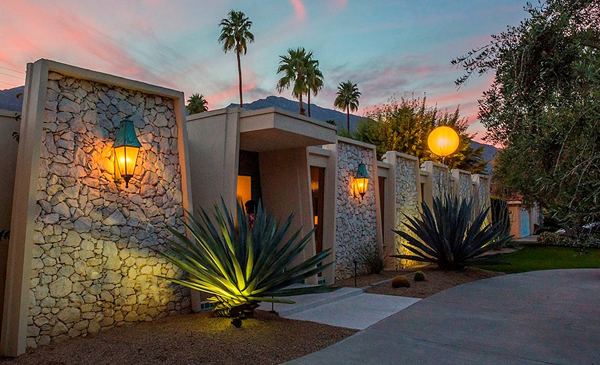
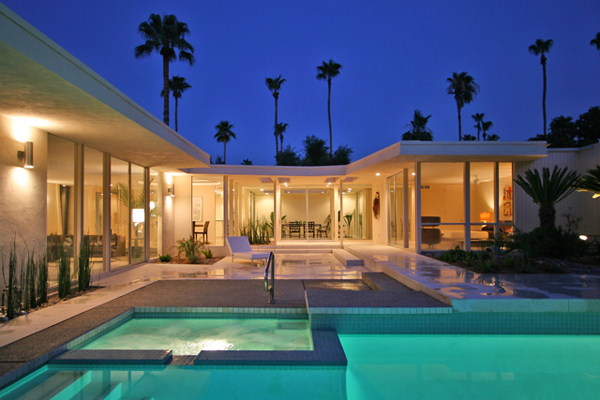
The Abe & Marion Schwartz Residence, constructed in 1964, has been expertly attributed to Hollywood architect Harold “Hal” Levitt. As an important and largely intact example of a custom modernist structure, the Schwartz Residence is a particularly “exuberant” example of the modernist aesthetic taking its design cues from a specialized geometric shape, the isosceles trapezoid. This shape is strongly expressed on the facade by coffered piers which alternate with the glazed openings of the facade. Overall this design, which cleverly couples a strong geometric shape with the luster and rough texture of the quartzite, conveys a sense of innovation.

REFERENCES

On January 24, 2018 the Palm Springs city council unanimously approved (4-0) the Class 1 Historic Site designation of the Schwartz Residence. PSPF board member Barbara Marshall made public comment in support of the nomination calling the Schwartz Residence “an exuberant example of the city’s mid century architecture.” City council members kindly lauded PSPF on the nomination and council member Kors commented that it was “a joy to read.”

On November 14, 2017 the city’s Historic Site Preservation Board voted unanimously to recommend to city council approval of the Class 1 Historic Site designation of the Schwartz Residence.

On October 24, 2016 the Palm Springs Preservation Foundation (acting as agent for the owners) submitted the Class 1 Historic Site nomination for the Abe and Marion Schwartz Residence to the Palm Springs Historic Site Preservation Board. The 47-page nomination was prepared by PSPF board members Ron and Barbara Marshall.
Schwartz Residence
Schwartz Residence
Categories
Historic Sites

Sinatra Twin Palms Estate

Frank Sinatra’s Twin Palms Estate 1145 East Via Colusa, Palm Springs, CA 92262

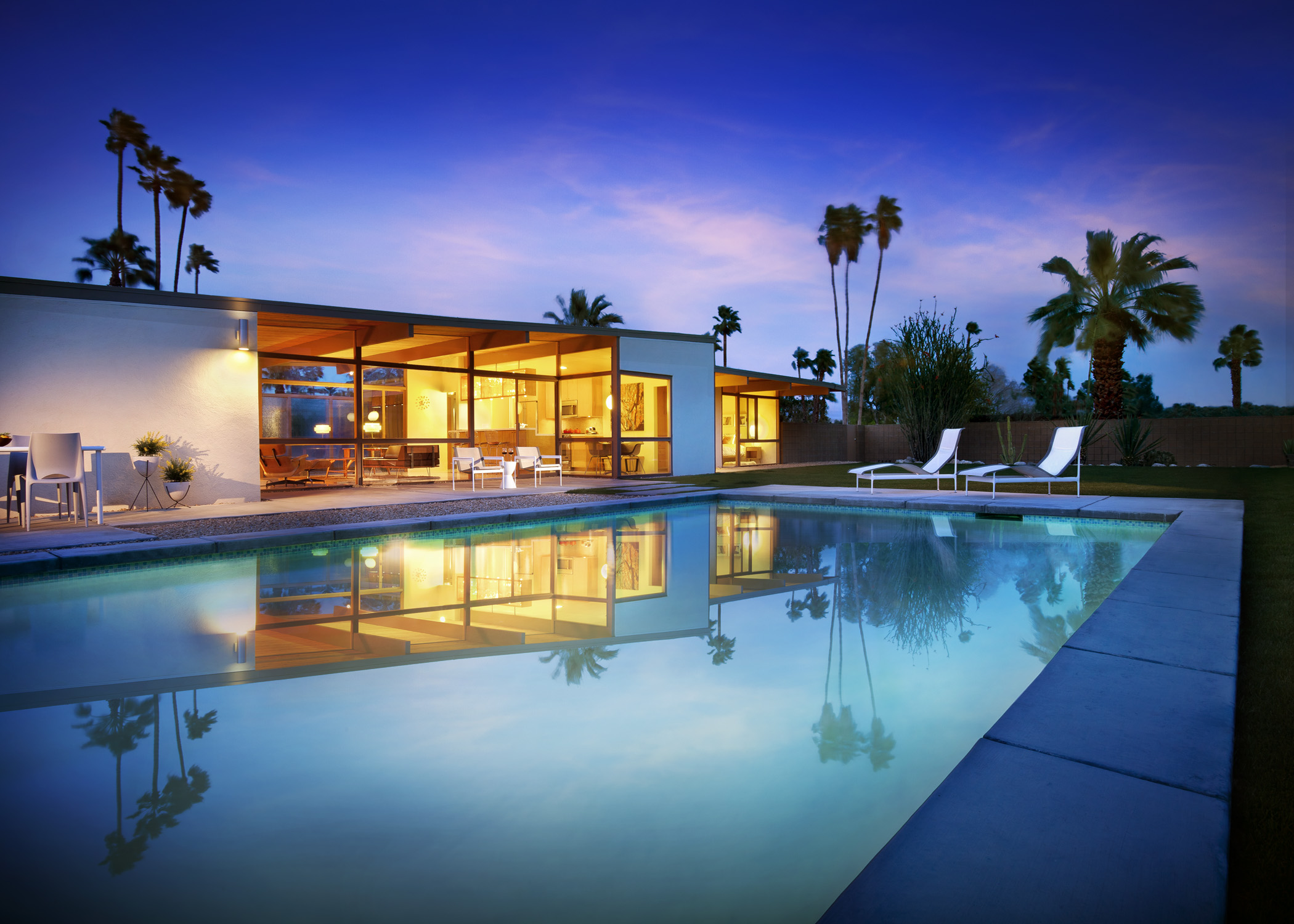
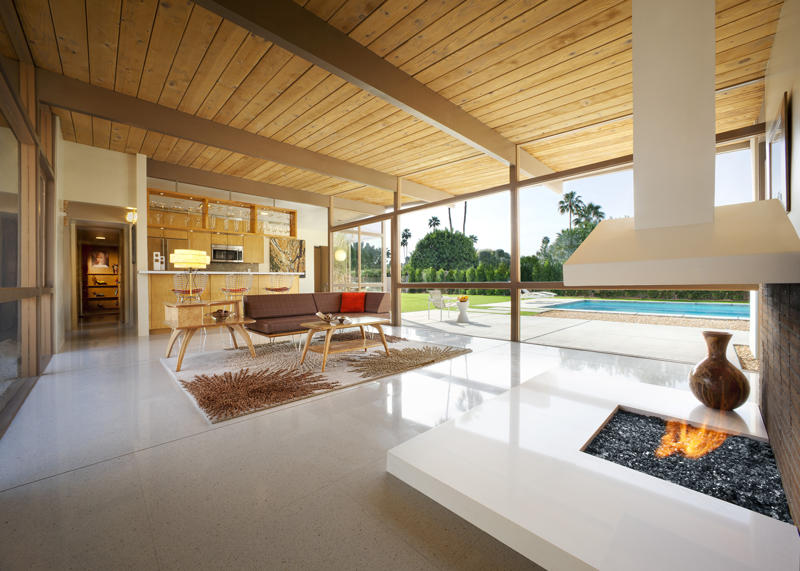
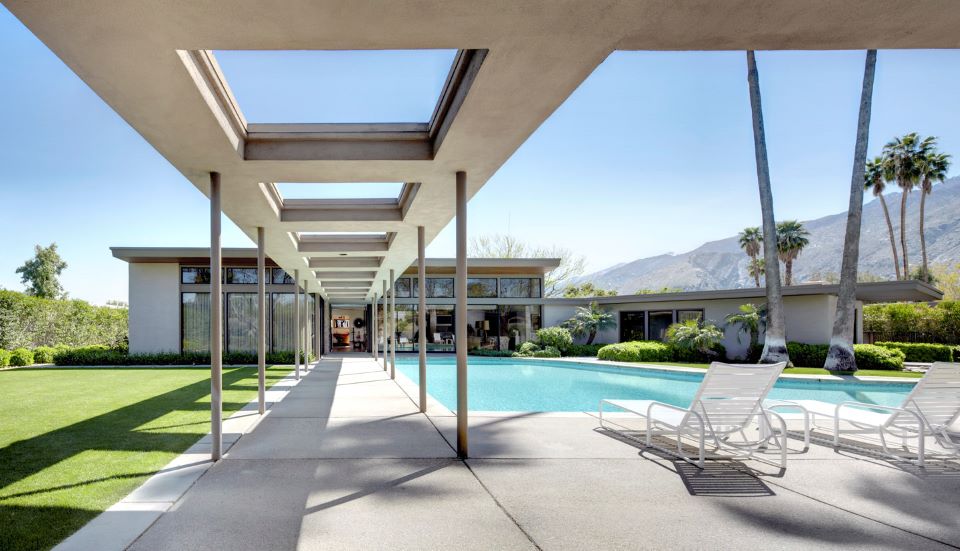
Frank Sinatra’s Twin Palms estate was designed in 1947 by architect E. Stewart Williams of the firm of Williams, Williams & Williams. The estate was named after the two large palm trees that still grace the site. The residence has a number of notable architectural features including tongue-in-groove Douglas Fir for the soaring sloping ceilings, generous use of glass, Arizona flagstone for the chimney stacks, etc. There is also a large swimming pool sheltered on three sides by the main house, pergola and cabana. The house and elements of the site were designated a city of Palm Springs Class 1 Historic Site in 2011.

REFERENCES

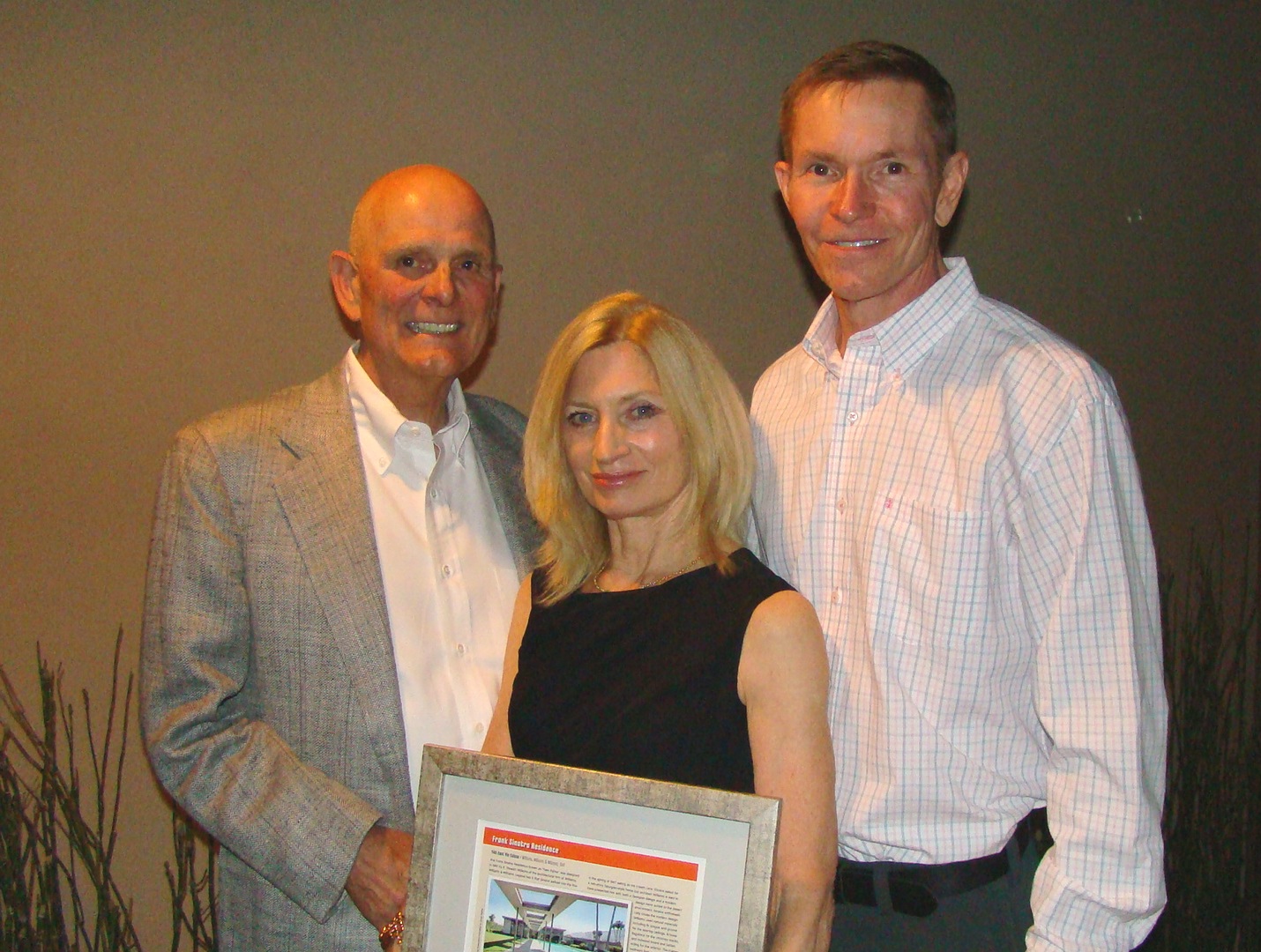
On October 13, 2011 the PSPF board of directors and homeowners Tom & Marianne O’Connell hosted a recognition ceremony to celebrate the Class 1 historic site designation of the Frank Sinatra’s Twin Palms estate. Councilmember Rick Hutcheson presented the homeowners with a framed copy of the residence’s future entry in PSPF’s Class 1 historic sites booklet.

On March 16, 2011 the Palm Springs city council voted unanimously (4-0) to approve the Class 1 historic site designation of Frank Sinatra’s Twin Palms estate. PSPF board member Erik Rosenow spoke in support of the nomination characterizing the residence as “great midcentury design combined with Hollywood lore.”

Background

On February 8, 2011, the city’s Historic Site Preservation Board voted 5-0 to recommend approval of the Class 1 historic site nomination of Frank’s Sinatra’s Twin Palms estate to the city council. The city council will make a decision regarding the final approval of the nomination in the coming months.

On December 27, 2010 the Palm Springs Preservation Foundation submitted the Class 1 historic site nomination of Frank Sinatra’s Twin Palms estate to the city of Palm Springs on behalf of homeowners Tom and Marianne O’Connell. Built in 1947 and designed by architect E. Stewart Williams, the Twin Palms residence is one of the finest examples of modernist architecture in Palm Springs. The hoped for historic designation of Sinatra’s former home will ensure that future changes to the property will be approved by the city’s Historic Site Preservation Board.

Local lore recounts that Frank Sinatra walked into architect E. Stewart Williams’ office in late spring of 1947 eating an ice cream cone, snapping his fingers, and saying, “I want to build a house and I want it done by Christmas.” With this important commission, Williams was allowed to put his own unique stamp on modern architecture. Among its many features, the house curls around a large pool in a pinwheel fashion revealing spectacular views of the San Jacinto Mountains from the master bedroom. The Sinatra residence remains remarkably intact and has been only slightly modified over the years (the main entrance configuration was reoriented in the late 1990s).

Unlike many so-called “celebrity homes” having tenuous connections to their namesakes, Frank Sinatra lived in his Twin Palms residence for six years starting in 1947, a significant time in both his personal and professional career, including the period of his tumultuous marriage to actress Ava Gardner. The enduring interest in both Frank Sinatra and modern architecture allows PSPF to hold a popular tour of the home every February during Modernism Week.

The Palm Springs Preservation Foundation selected Patrick McGrew, an architect, author and authority on California’s architectural history to write the historic site nomination. According to McGrew, Sinatra’s residence meets many of the criteria required for eventual historic site designation. Funding for the Twin Palms historic site nomination was made possible through donations from PSPF members Joe and Kim Zakowski & Ron and Barbara Marshall.

Courtesy James Haefner
Courtesy John Lewis Marshall
Sinatra O'Connells and RHutcheson
Categories
Historic Sites

Sunmor Model Home

Sunmor Model Home 2821 Livmor Avenue, Palm Springs, CA 92262

The Sunmor Model Home was designed by the architectural firm of Wexler & Harrison in 1955. Constructed by talented builder Robert “Bob” Higgins, the structure was the first of eleven modernist tract homes eventually realized in Sunmor Estates. The Higgins-built homes are notable for the quality of their construction and they blend seamlessly with the Alexander Construction Company homes (“Alexanders”) built around them just a few years later. Builder Bob Higgins holds a special place in Palm Springs’ architectural history having been responsible for the construction of many of the city’s most notable modernist structures including the L’Horizon Hotel and the Kirk Douglas Residence.

REFERENCES

On January 30, 2020 the Palm Springs city council voted unanimously (5-0) to approve the Class 1 Historic Resource designation of the Sunmor Model Home. Susan Secoy Jensen (PSPF advisor and author of the nomination) spoke on behalf of the nomination.

On November 12, 2019 the city’s Historic Site Preservation Board voted unanimously (7-0) to recommend to city council approval of the Class 1 Historic Resource designation of the Sunmor Model Home. PSPF advisor and nomination author Susan Secoy Jensen made public comment in support of the nomination.

On August 6, 2019 the Palm Springs Preservation Foundation (acting as agent for the owner) submitted the 47-page Class 1 Historic Site nomination for the Sunmor Model Home to the Palm Springs Historic Site Preservation Board.

In March of 2019, the Palm Springs Preservation Foundation board of directors assigned the task of writing the Class 1 Historic Site nomination of the Sunmor Model Home to PSPF board advisor Susan Secoy Jensen.

Courtesy Susan Secoy Jensen
Categories
Historic Sites

Town & Desert Apartments

Town & Desert Apartments 370 West Arenas Road, Palm Springs, CA 92262

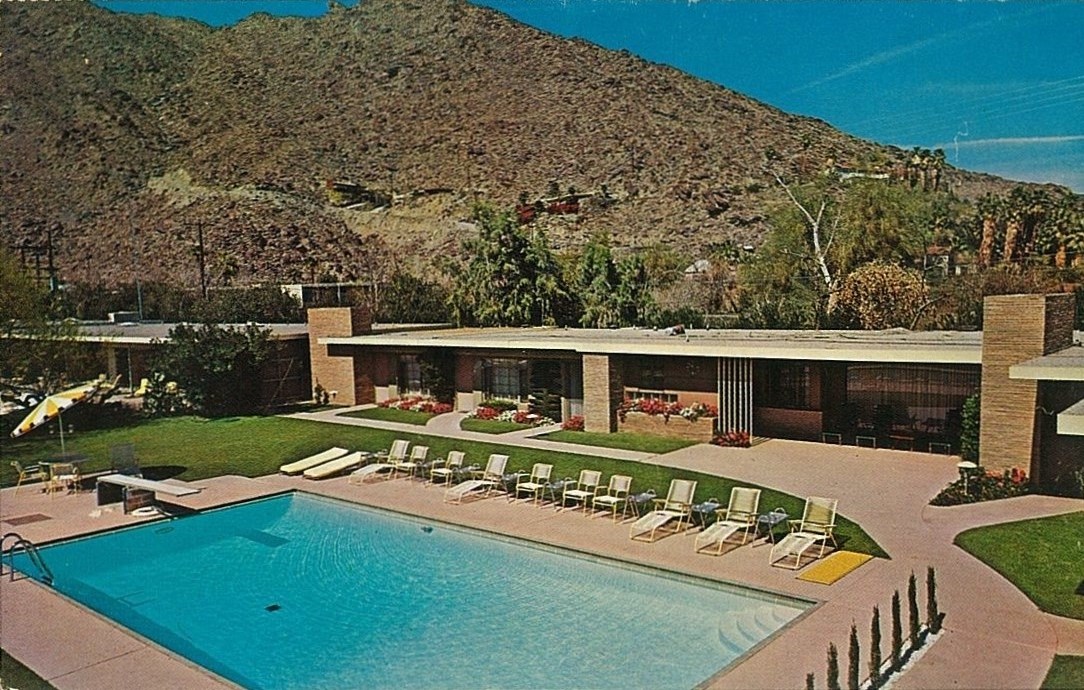
When opened to the public on October 1, 1947 the Town & Desert Apartments (today the “Hideaway”) were described as the “apartments of tomorrow”. Designed by Palm Springs architectural designer Herbert W. Burns, the complex received national attention when it was published in the May 1948 issue of Architectural Record in an article entitled “California Hide-Away, Motel Style.” The 1948 Architectural Record article was lavishly illustrated with photographs by architectural photographer Julius Shulman.

REFERENCES

On July 2, 2014 the Palm Springs city council voted unanimously (4-0) to approve the Class 1 Historic Site designation of the Town & Desert Apartments (now the Hideaway). PSPF president Erik Rosenow made public comment in support of the designation stating that “this will be the first [Class 1 Historic Site] designation to recognize architectural designer Herbert Burns, so your action tonight will be making a bit of history in its own right.” Rosenow also lauded the property owners’ many contributions to the community and to Modernism Week.

On June 10, 2014 the Town & Desert Apartments Class 1 Historic Site nomination was reviewed by the city’s Historic Site Preservation Board. The HSPB unanimously approved sending the nomination forward to the city council. PSPF board member Ron Duby made public comment in support of the nomination and HSPB members lauded the quality of the research found in the PSPF submission.

On March 26, 2014 the Palm Springs Preservation Foundation (acting as agent for the owners) submitted the Class 1 Historic Site nomination for the Town & Desert Apartments to the city’s Historic Site Preservation Board. The 40-page nomination was prepared for PSPF by PSPF board members Ron and Barbara Marshall.
Vintage postcard circa 1960

IN THE MEDIA

Volume 8 Issue 2, Preservation Matters (All Things Mod: Modernism Week in Palm Springs)

Categories
Historic Sites

Villa Royale

Villa Royale 1620 South Indian Trail, Palm Springs, CA 92264

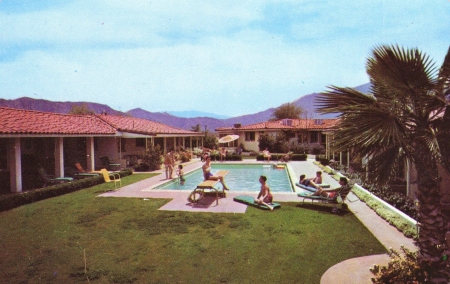
Villa Royale (as configured today) is best described as a variety of California-style ranch structures surrounding three separate courtyards. Courtyard 1 is the original Villa Royale (1947-51) designed by Los Angeles-based home designer Kenneth Dreisbach and built over four years by Palm Springs contractor Ralph Young. Courtyard 2 was originally the small hotel Indian Trail Villa and was built in 1950. Courtyard 3 was originally the small hotel Country Manor and was built in 1956. Both became part of Villa Royale when they were purchased in 1985.

REFERENCES

On April 7, 2016 the owner of Villa Royale requested that the Class 1 Historic Site nomination be held in abeyance.

On January 7, 2016 PSPF submitted the Class 1 Historic Site nomination of the Villa Royale (1947, Kenneth Dreisbach) to the city of Palm Springs. The 54-page nomination was authored by PSPF researcher Melissa Riche.

Vintage postcard circa 1951
Categories
Historic Sites

Village Manor

Village Manor 562 West Arenas Road, Palm Springs, CA 92262

The Village Manor was designed by architectural designer Herbert Burns in 1955. The small hotel still features many of the original interiors (including pink tile bathrooms) and was one of the first midcentury hotels in Palm Springs to be sympathetically rehabilitated. The hotel operates today as the Orbit In and has gained national recognition as one of Palm Springs’ “destination hotels” with its sublime midcentury architecture and desert resort ambiance.

REFERENCES

On January 13, 2016 the Palm Springs city council unanimously approved (5-0) the Class 1 Historic Site designation of the Village Manor. Making public comment in enthusiastic support of the nomination was PSPF board member Barbara Marshall who congratulated the author for the well-written nomination. Marshall also recognized the continuing stewardship of the current owners.

On June 9, 2015 the city of Palm Springs’ Historic Site Preservation Board met and voted unanimously (7-0) to forward a proposed resolution to the city council to designate the Village Manor a Class 1 Historic Site.

On April 1, 2015 PSPF member Jade Nelson submitted the 40-page Class 1 Historic Site nomination for the Village Manor to the city of Palm Springs. Nelson graciously recognized the previous research done on architect Herbert Burns by PSPF board members Ron and Barbara Marshall.

Photo by Dan Chavkin, Courtesy Jade Nelson
Categories
Historic Districts

Business Historic District

Business Historic District Palm Springs, California

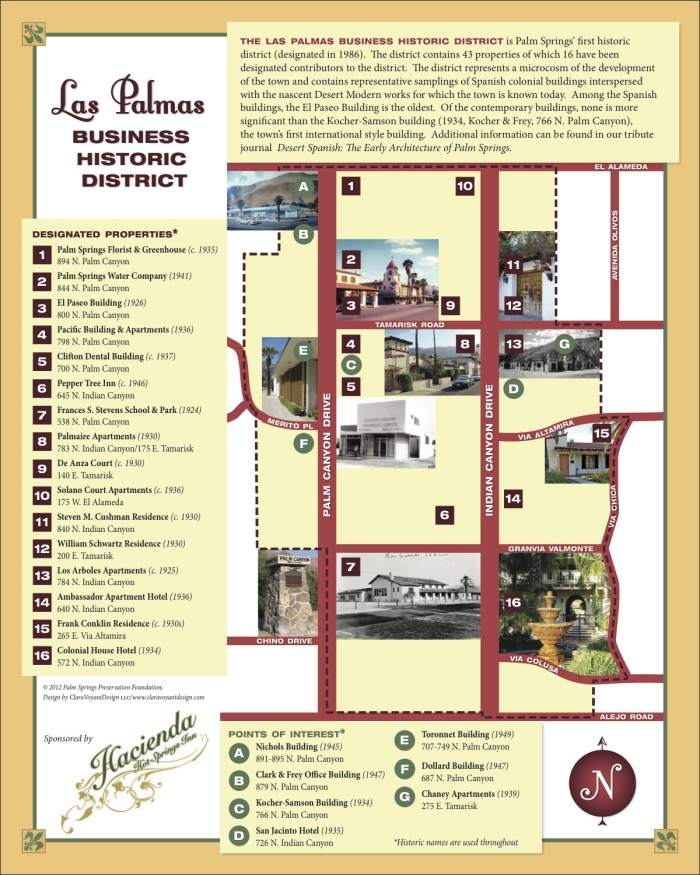
On September 14, 2023, the Palm Springs city council voted unanimously (5-0) to approve amendments to the Las Palmas Business Historic District.  According to the city staff report, the “amendments better reflect the significant historic resources of the area and bring the district into compliance with current national standards and the City’s recently updated historic preservation ordinance.” 

To read the city staff report click here.

On December 7, 2021, after several unsuccessful attempts over the years, the city’s Historic Site Preservation Board unanimously agreed to updates to the Las Palmas Business Historic District. The updates included adopting a context statement; establishing the period of significance as 1920 through 1969; evaluating individual sites and buildings which added to the percentage of contributing properties in the district, strengthened the commercial theme, and added important post-war commercial buildings that were not considered in the establishment of the district in 1986; and amending the boundaries of the district.

At the August 11, 2009 Historic Site Preservation Board (HSPB) meeting, city staff announced that while cleaning out files they “discovered” paperwork regarding an administratively forgotten historic district. The Las Palmas Business Historic District was created by Palm Springs City Council Resolution No. 15858 on May 7, 1986 – more than 23 years ago. City staff indicated that a legal review of the documentation revealed that the historic district remains valid. The full implications of this discovery will be the topic of the September 8, 2009 HSPB meeting. In short, the properties designated as Class 3 and Class 4 sites under the city’s earlier preservation ordinance are equivalent to (respectively) non-contributing and contributing properties in an historic district. Future proposed alterations to these historic properties (whether contributing or non-contributing) will require review by the city’s HSPB.

Categories
Historic Districts

Desert Holly

Desert Holly 2244 East Tahquitz Canyon Way, Palm Springs, CA 92262

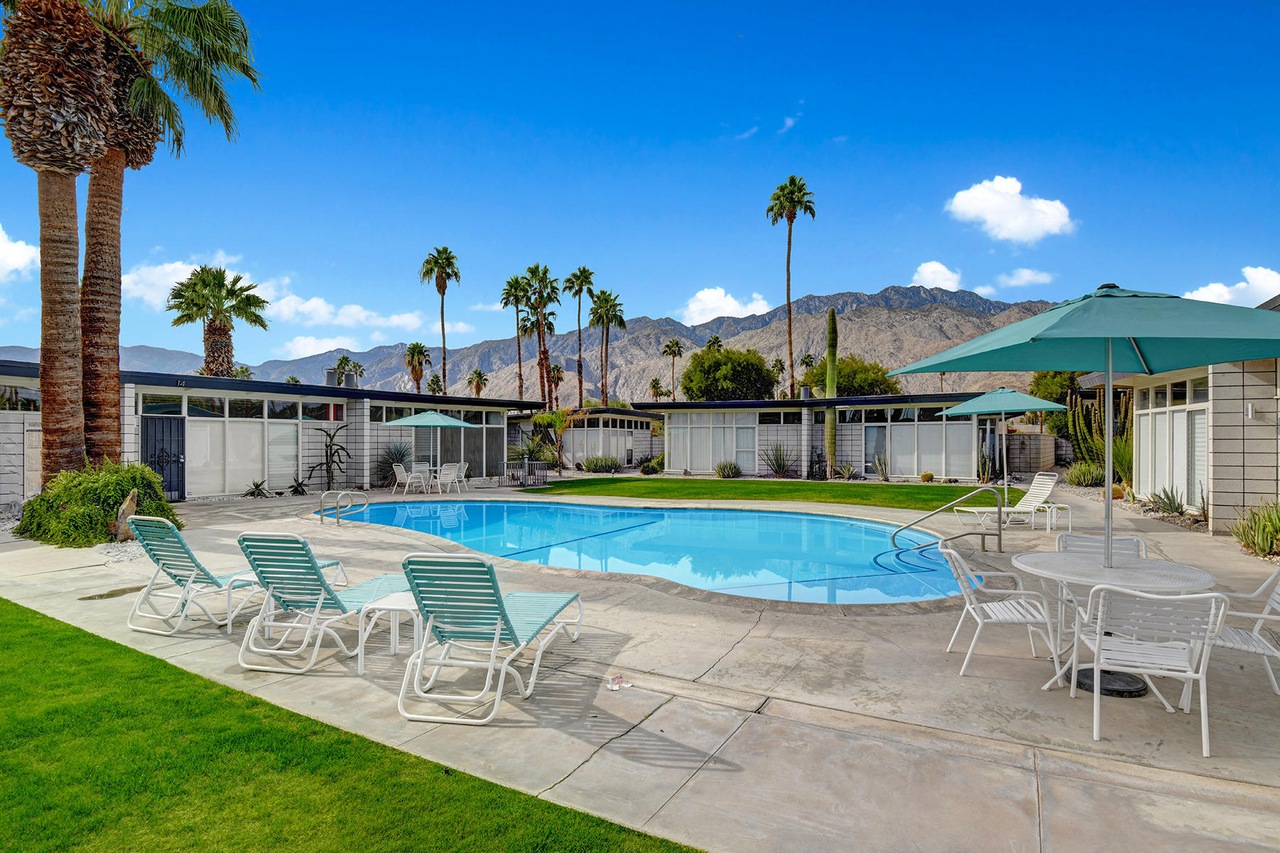
Built in 1957, Desert Holly is a 14-unit complex comprised of eight buildings. The buildings surround a recreational area whose major component is a large pool. The beautiful modernist complex was constructed by talented Long Beach master builder and developer William J. O’Brien, Jr. Originally a cooperative, Desert Holly was converted to condominiums in 1998. Desert Holly is visible from one of the city’s busiest streets.

REFERENCES

On January 9, 2020 the Palm Springs city council voted unanimously (5-0) to approve the creation of the Desert Holly Historic District. PSPF board advisor Susan Secoy Jensen made public comment in support of the designation. Desert Holly becomes the city of Palm Springs’ seventh historic district.

On October 8, 2019 the city of Palm Springs’ Historic Site Preservation Board met and voted unanimously (4-0) to recommend to the city council the creation of the Desert Holly historic district. PSPF board member Ron Marshall made public comment in support of the nomination. Desert Holly homeowner Jim Hanlin commented that historic designation was supported by 100% of Desert Holly residents and thanked PSPF for helping with the nomination. HSPB board member Dick Burkett graciously took time to compliment PSPF’s efforts with regard to historic nominations in general.

On March 14, 2019 the Palm Springs Preservation Foundation (acting as agent for the owners) submitted the 42-page Historic District nomination for Desert Holly to the Palm Springs Historic Site Preservation Board.

On March 15, 2018, PSPF was notified by the Desert Holly Homeowners Association (HOA) that they had voted to pursue historic district designation. Palm Springs Preservation Foundation board members Ron and Barbara Marshall volunteered to write the Desert Holly Historic District nomination.

Desert Holly Courtesy Desert Holly HOA
Courtesy james butchart PHOTOGRAPHER
Categories
Historic Districts

Pompeii de Las Palmas

Pompeii de Las Palmas 221 West Stevens Road, Palm Springs, CA 92262

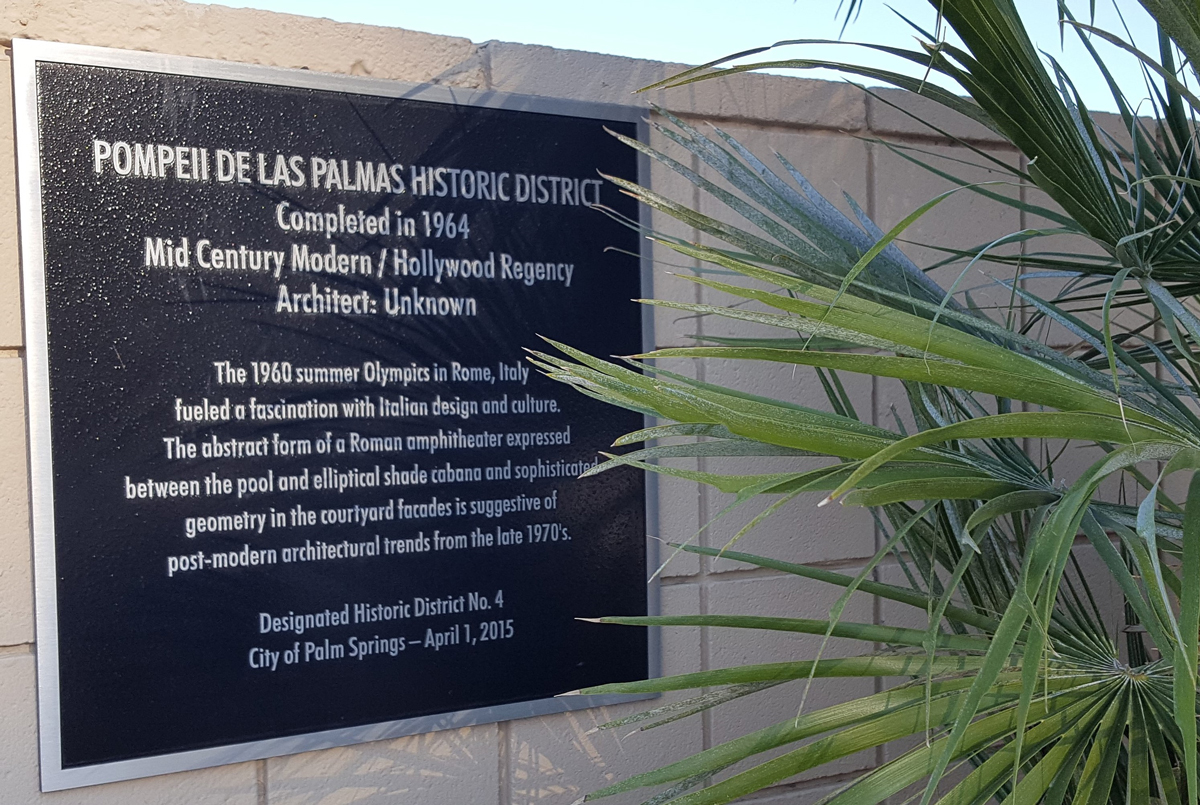
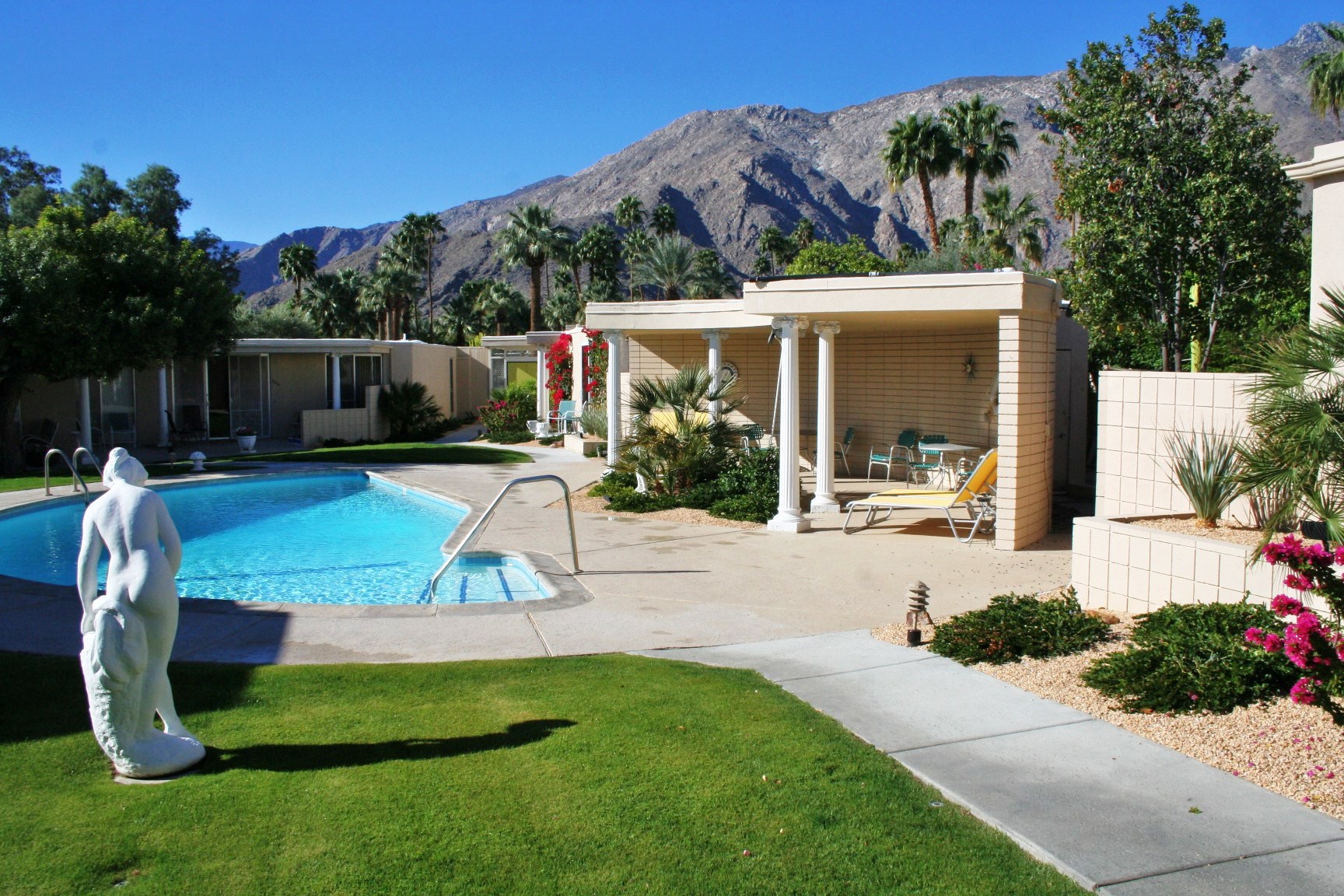
The Pompeii de Las Palmas (PDLP) complex is a nine-unit property located in the historic Old Las Palmas neighborhood. Originally constructed in 1964 as apartments, the complex was converted to condominiums in 1969. The PDLP complex is a beautiful example of modernist architecture in the quirky Roman Revival style. Possibly of more importance, the PDLP complex is an excellent example of a vanishing and endangered building type: the “small” seasonal rental property or hotel/apartment.

REFERENCES

On April 1, 2015 the Palm Springs city council voted 4-1 (with Pougnet, Foat, Hutcheson and Lewin supporting) to approve the creation of the Pompeii de Las Palmas (PDLP) Historic District. PSPF President Erik Rosenow and two PDLP homeowners mad public comment in support of the designation. PDLP becomes the city of Palm Springs’ fourth historic district.

On March 10, 2015 the city of Palm Springs’ Historic Site Preservation Board met and voted 6-1 to forward a proposed resolution to the city council to create the PDLP historic district.

On January 8, 2015 PSPF delivered the PDLP Historic District nomination to the city’s Planning Department.

On May 22, 2014 PSPF was provided with various documents of owner support indicating that more than two-thirds of the PDLP owners supported pursuing historic district status.

On March 24, 2014 PSPF was notified by a representative of the Pompeii de Las Palmas Homeowners Association that during their annual meeting (on March 1, 2014) the Pompeii de Las Palmas Homeowners Association had voted unanimously to pursue the historic district designation of their condominium complex.

Pompei-de-la-Palmas-plaque-web-BAM-e
Pompeii de las Palmas BAM
Categories
Historic Districts

Racquet Club Cottages West

Racquet Club Cottages West 360 West Cabrillo Road, Palm Springs, CA 92262

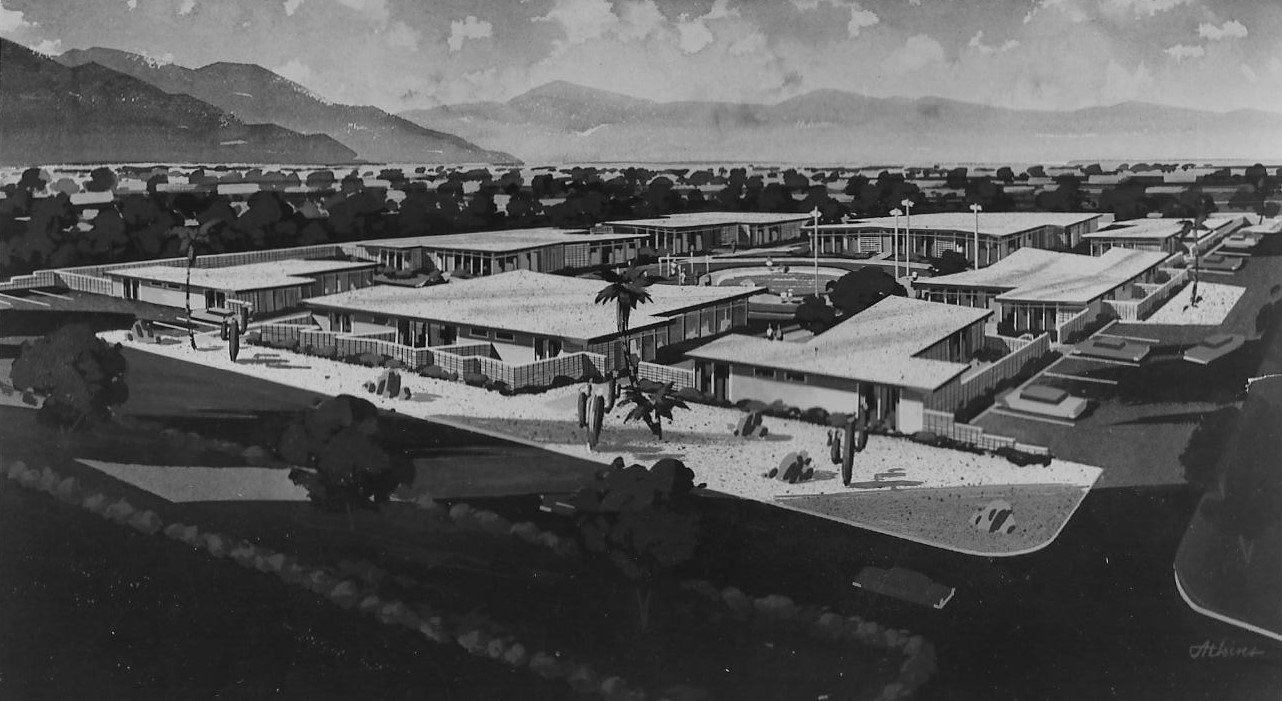
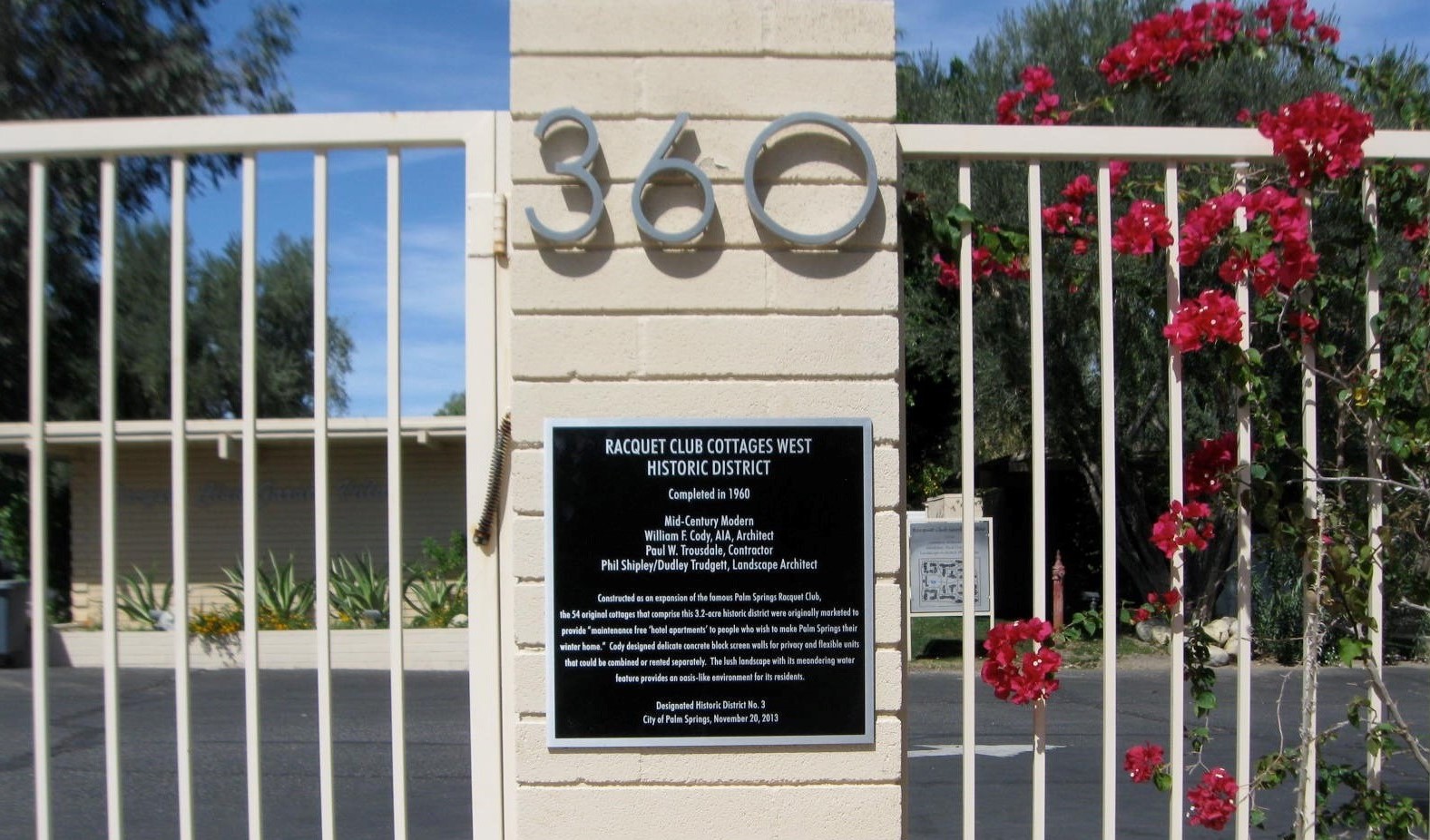
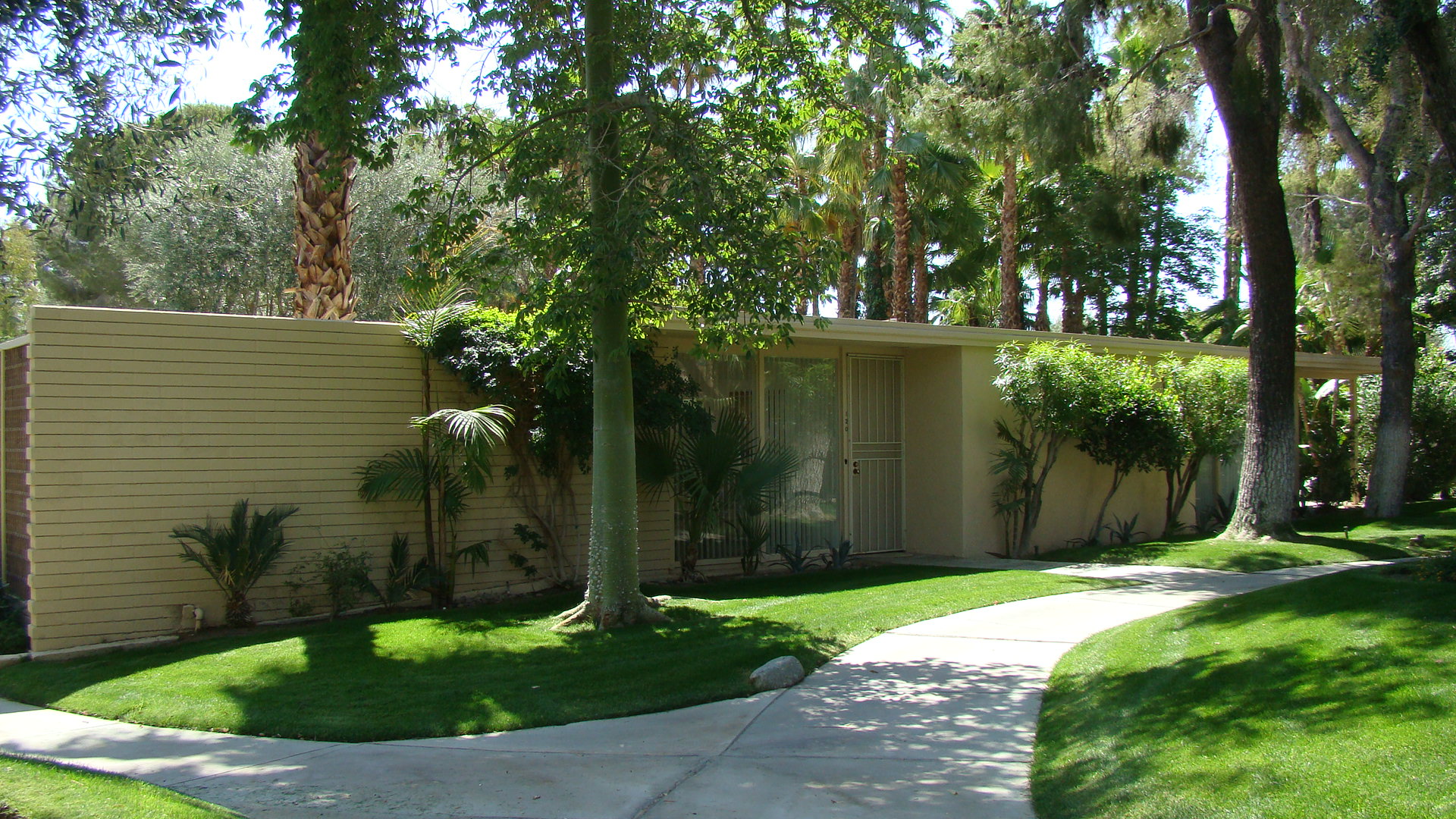
Constructed on land adjacent to the world-famous Racquet Club, the Racquet Club Cottages West (RCCW) complex (today Racquet Club Garden Villas) is a group of 37 modernist condominiums designed by master architect William F. Cody, FAIA and built by developer Paul Trousdale. Constructed from 1959 through 1960, the RCCW complex features landscape architecture by the firm of Phil Shipley and Associates.

REFERENCES

On March 17, 2014 the city of Palm Springs installed the historic district plaque for Racquet Club Cottages West.

On November 20, 2013, amidst a sea of waving tennis racquets, the Palm Springs City Council voted unanimously (4-0 with one recusal for business reasons) to make Racquet Club Cottages West (today known as Racquet Club Garden Villas (RCGV)) the city’s third historic district. Enthusiastic and compelling public comment in support of the designation was made by PSPF president Erik Rosenow and RCGV Homeowners Association president Kim Zakowski. Both speakers noted the scholarly content of the nomination and the overwhelming owner support for the historic designation. Councilmember Ginny Foat commented that on a recent visit to the RCCW complex one could still “feel the history” of the property.

On November 12, 2013 the city of Palm Springs’ HSPB met and voted unanimously (4-0 with one recusal for business reasons) to forward a proposed resolution to the city council to create the RCCW historic district. The city council meeting to decide the matter is scheduled for November 20, 2013. On October 13, 2013 the city of Palm Springs’ Historic Site Preservation Board (HSPB) met to discuss the historic district nomination of the Racquet Club Cottages West. The HSPB voted unanimously (4-0 with one recusal for business reasons) to recommend the creation of the historic district to the city council. The HSPB also directed staff to prepare a resolution for the HSPB’s review at their November meeting.

On May 23, 2013 PSPF submitted the historic district nomination for the RCCW complex to the city of Palm Springs. The nomination was written by PSPF board member Ron Marshall.

The Racquet Club Garden Villas (RCGV) Homeowners Association (HOA), in partnership with PSPF, is pursuing historic district status and as of early May 2013 a majority of the RCGV homeowners have already signed a “document of support” for the effort.

Photo courtesy Racquet Club Garden Villas
Racquet Club Cottages West2 BAM
Racquet Club Cottages West3 BAM
Racquet Club Cottages West4 BAM